Whenever I visit museums or cultural institutions, I like to play a game called “Find the Livingston.” It’s an extraordinarily easy game to play in the northeast, because there are so many Livingston descendants and so many of them have been generous in their institutional giving. Between monetary donations and family heirlooms, you’re hard pressed not to find a portrait, a gift, or name emblazoned in gold. The Metropolitan Museum of Art is no exception.

By Hugo Schneider – Flickr, CC BY-SA 2.0
The Livingston family has had deep connections to The Met throughout its 150+ year history. Most prominently, Roland Livingston Redmond, of Callendar House in Tivoli, was president of The Met from 1947 to 1964.

Roland Livingston Redmond, photo undated.
During his tenure, he helped grow museum attendance from 2 million in 1947 to 5.5 million in 1964. He oversaw massive improvements to the museum’s facilities, stewarded a major exhibition of the Mona Lisa in 1963, and was accused, many times, of being hostile towards modern art and artists.

By Jimmy Ernst, Adolph Gottlieb, Robert Motherwell, William Baziotes, Hans Hofmann, Barnett Newman, Clyfford Still, Richard Pousette-Dart, Theodore Stamos, Ad Reinhardt, Jackson Pollock, Mark Rothko, Bradley Walker Tomlin, Willem de Kooning, Hedda Sterne, James Brooks, Weldon Kees, Fritz Bultman, Herbert Ferber, David Smith, Ibram Lassaw, Mary Callery, Day Schnabel, Seymour Lipton, Peter Grippe, Theodore Roszak, David Hare, Louise Bourgeois
The Livingston family have always been major donors to the collection. Perhaps the grandest contribution of all arrived in the 1920s, when Van Rensselaer and Livingston descendants began the lengthy process of donating the large entrance parlor of Van Rensselaer Hall.

Courtesy of the Metropolitan Museum of Art.
The Georgian manor house from which this room came was deconstructed in the early 20th century. Its original woodwork, wallpaper, and furniture were briefly scattered across various family homes and family alma maters. In 1928, the Van Rensselaer Hall was collected, accessioned, and carefully reassembled in the newly updated American Wing. The room was delicately restored again in the 1970s.

Courtesy of the Metropolitan Museum of Art.
The historic hall takes up the entirety of Gallery 752, where museum visitors can stroll through the grand space as though they are guests in the fallen mansion. The space was interpreted to the 1760s interior design styling of Catherine Livingston Van Rensselaer, daughter of Phillip Livingston “The Signer” and Christina Ten Broeck Livingston, whose portraits have overseen visitors to Clermont’s drawing room for over a century.

Clermont’s Drawing Room, c. 2006. Phillip Livingston is shown prominently with Christina reflected in the mirror.

Clermont’s Drawing Room, c. 1940. Christina sits over the piano forte, as she does to this day. We know from John Henry Livingston’s memoirs that these paintings were in the Drawing Room during his childhood in the mid-19th century.
“Find a Livingston” is even easier when you expand the search beyond the last name. You’ll find Schuylers, the aforementioned Van Rensselaers, Millses, Roosevelts, Astors, Fultons, Fishs, Hamiltons, etc in nearly every cultural institution across the country. Two of my favorite extended-family-Livingston-finds at The Met are a bust of Robert Fulton, located in Gallery 553, and a tiny bronze statuette of Fortuna, donated by Ogden Mills, located in Gallery 536.

Title: Robert Fulton (1765–1815) Artist: Jean Antoine Houdon (French, Versailles 1741–1828 Paris) Medium: Painted plaster. Date: 1803-4
Courtesy of the Metropolitan Museum of Art.

Title: Fortuna Artist: After a model by Giambologna (Netherlandish, Douai 1529–1608 Florence) Artist: Possibly by Antonio Susini (Italian, 1558–1624 Florence) Medium: Bronze Date: early 17th century.
Courtesy of the Metropolitan Museum of Art.
For bonus points, sometimes I throw Washington Irving into the mix for his doomed relationship with Serena Livingston.

A copy of the Alhambra by Washington Irving is located in Gallery 454. The cover design is by Alice C. Morse (1863-1961,) Clermont has the same edition on display in the Study. After Irving’s request to marry Serena was denied by her father, John Livingston, Irving boarded a boat for Spain, hoping for inspiration now that his dreams of Serena were squashed. While in Spain, he penned The Conquest of Granada and The Alhambra.
I’ve considered looking for Jays, as John Jay’s wife Sarah was a Livingston daughter, but as a historian stewarding the legacy of the Livingstons of Clermont, I feel obligated to respect The Chancellor’s beef. (The Met does have a really cool John Jay artifact on display right now— you can view it on The Met’s website: https://www.metmuseum.org/art/collection/search/21125 )
Among all these names, you know you’ve truly “won” the game when you can tie the artifact directly to Clermont, especially so if the provenance comes from “Mrs. Reginald McVitty” “Honoria Livingston” or “Janet C. Livingston.”
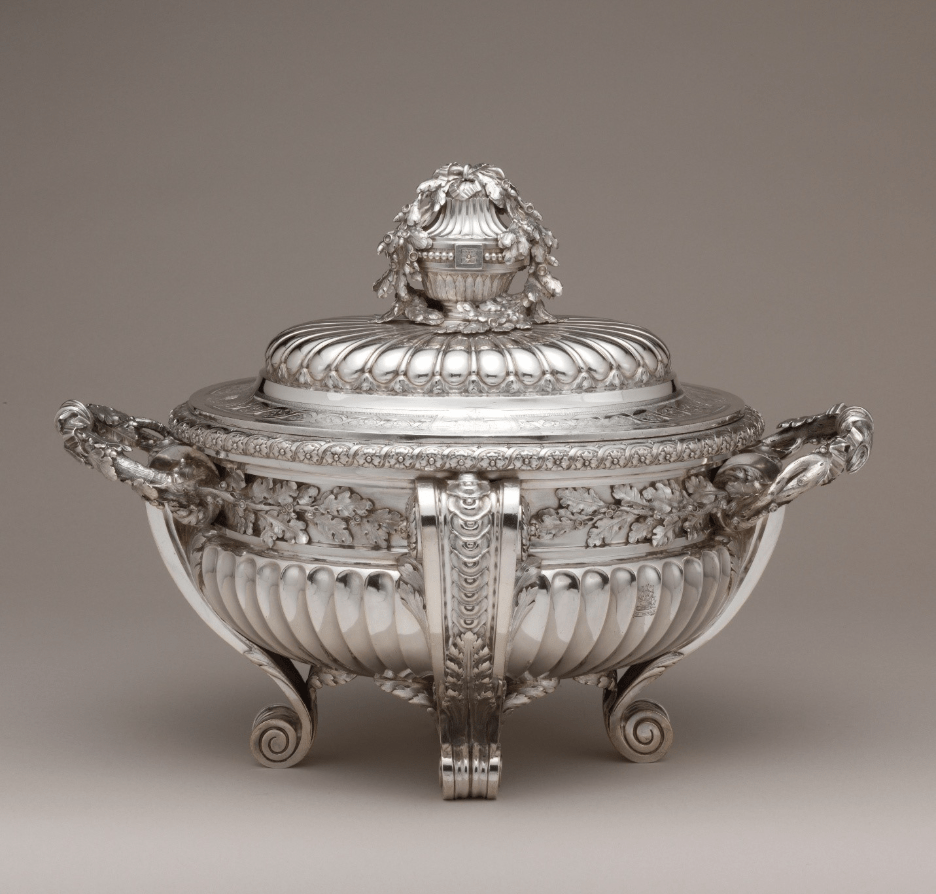
Title: Tureen with cover Maker: Jacques-Nicolas Roettiers (1736–1788, master 1765, retired 1777) Date: 1775–76 Medium: Silver. Provenance: Robert R. Livingston , Clermont, New York ; Mrs. Reginald McVitty ; and Estate of Janet C. Livingston.
Courtesy of the Metropolitan Museum of Art.
In my next installment, I will highlight several pieces from Clermont that are currently on view at The Met and how a game of “Find the Livingston” lead to a fascinating rediscovery in the American Wing!
 Clermont State Historic Site
Leave a comment