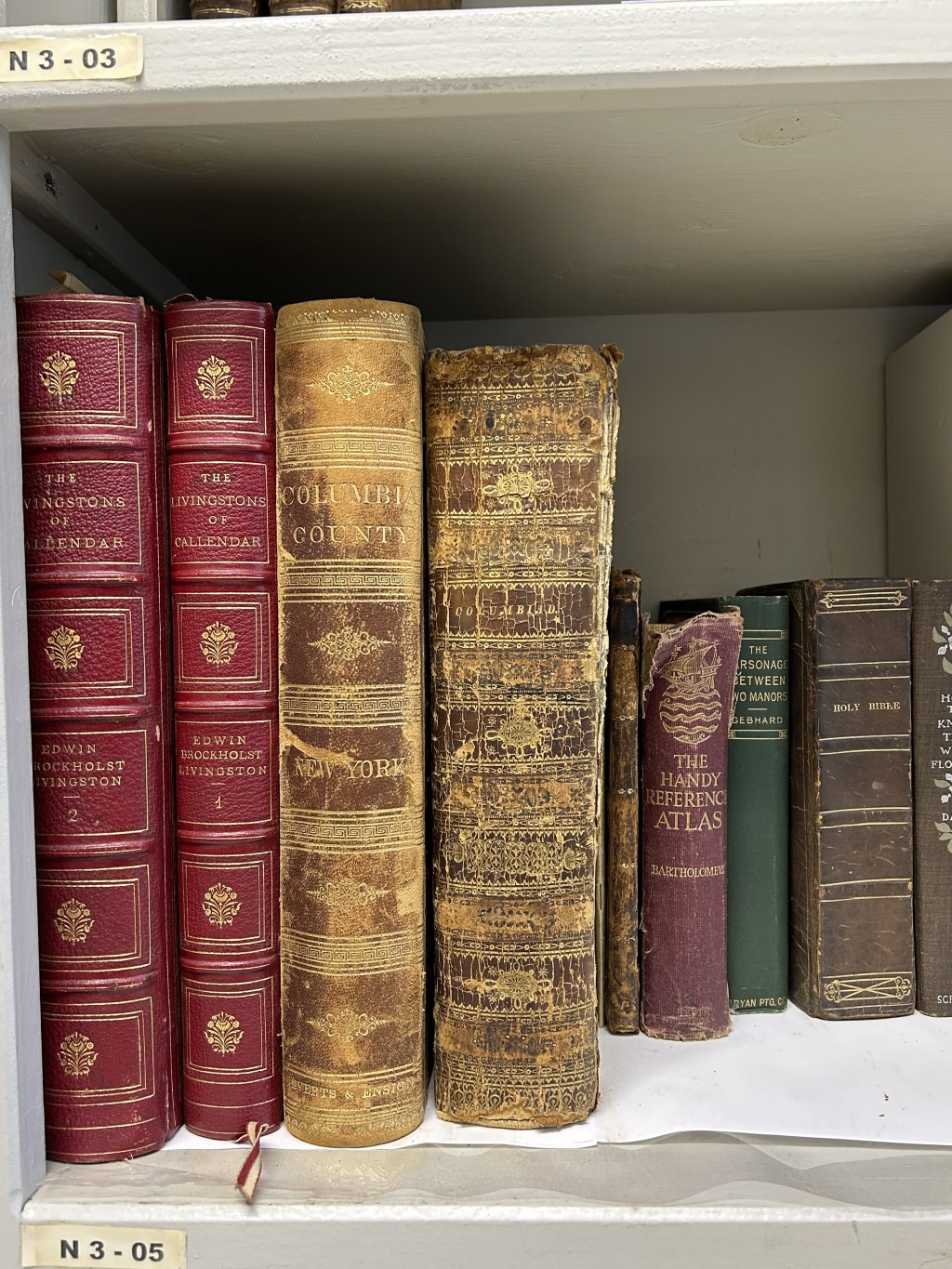
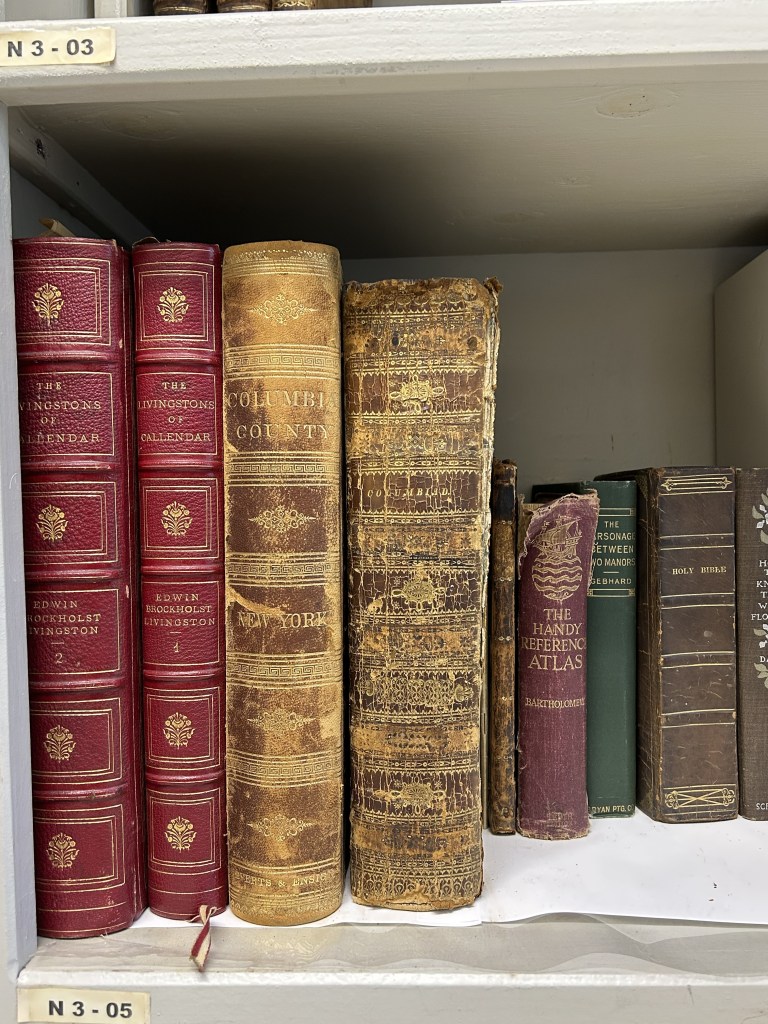
Hi everyone, curatorial assistant Dawson Escott here again with another obscure but really fascinating book I found while researching Clermont’s collection. But I’d like to start with a bit of a wider scope:
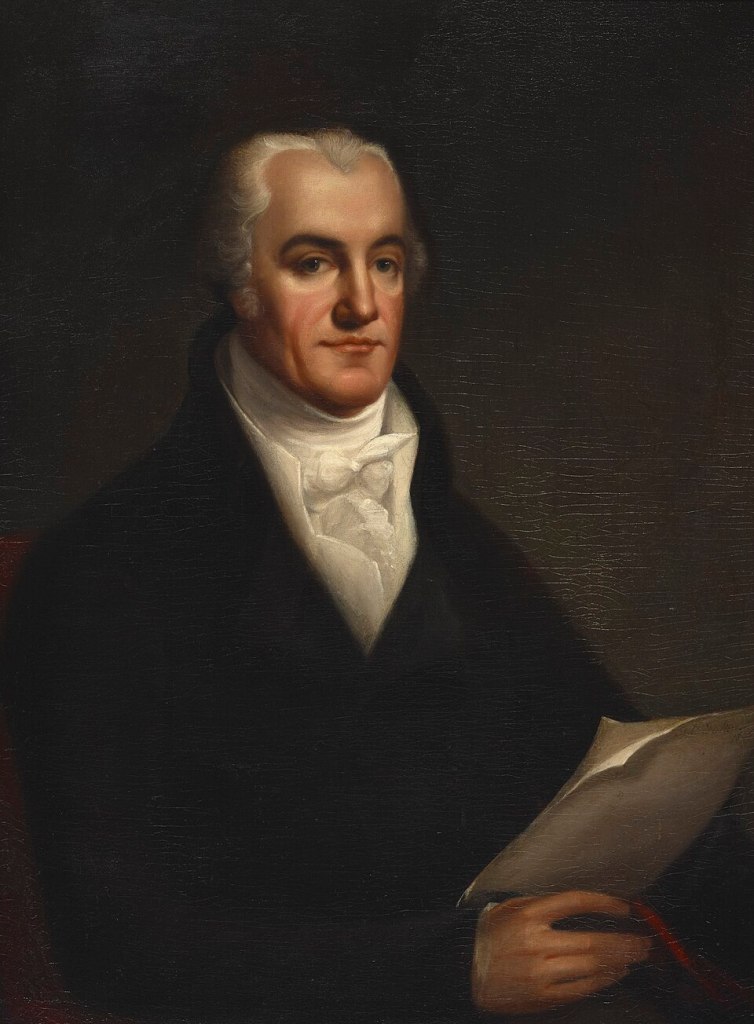
When the United States was a young nation, its writers faced an identity crisis. What would American literature look like? With its colonial relationship to England severed, should they still consider themselves heirs to the traditions of English literature? Should they instead break with traditional forms and style to make a new kind of literature somehow more uniquely and authentically American? Or should they model themselves after the culture of another nation, like John Vanderlyn adapted the stylings of French Neoclassicism in his painting? American post-revolutionary thinkers and writers had no obvious answers, just this vast field of options in front of them from which they must pick and choose. To have a clear direction forward for American culture, they had to establish an American identity, an ideal portrait of themselves and what they would like to become.
The construction of an American national identity, as you can imagine, was no small task, if not an impossible one. But in the midst of the revolution (while serving as a military chaplain), Connecticut poet Joel Barlow had already begun a poem which sought to tell the whole history of America, from Columbus’ landing to the present day. This poem, he hoped, would help cultivate national pride, but further, provide American citizens with a sense of continuity—would tell an ongoing story to which they themselves can then contribute. Barlow first published The Vision of Columbus in 1787, a poem in which Christopher Columbus, while imprisoned in Spain, is visited by an angel who shows him the history of America to come and thereby reassures him that his expeditions were not in vain. The history he tells is detailed and wide-spanning, making Barlow’s poem arguably the first American epic. Through the historical scenes he highlights, Barlow argues that from 1492 onwards, America moved towards an ideal universal liberty, and further, that this is the essential spirit of the United States and of the revolution. The poem even ends with an imagined future utopian, fully free and democratic society spanning across all nations. Upon its release, the poem was immensely popular. Barlow could boast of having such esteemed names as Washington, Franklin, Lafayette, and Chancellor Robert R. Livingston as his subscribers.
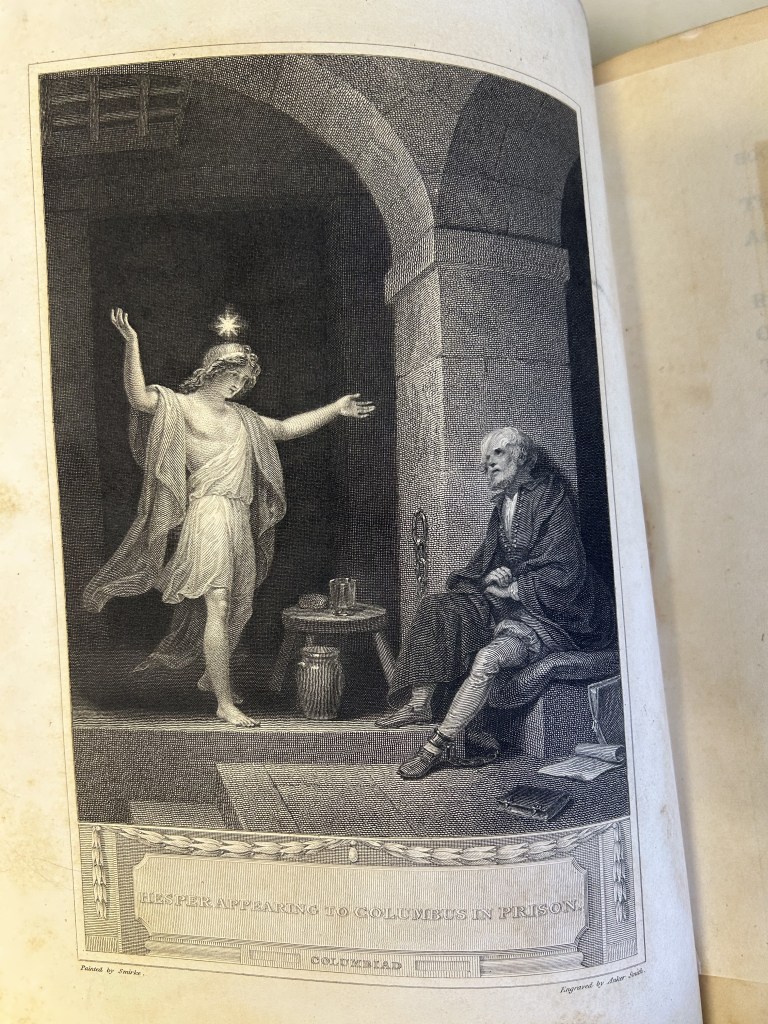
Over the following decades, Barlow refined and expanded this poem to 7,350 lines (nearly twice its original length!), finally releasing it in 1807 as The Columbiad, which can now be found in Clermont’s collection. Barlow has several ties to Clermont’s history which would easily explain it being on our shelves—both he and Robert R. Livingston were ardent Jeffersonian Democrats and Francophiles (both eventually serving as Ministers to France) and thereby ran in overlapping political circles. Further, the poem is dedicated to Robert Fulton, who was the business partner of Livingston in the making of his famous steamboat. Fulton’s relationship with Barlow is almost too juicy to discuss in an aside and really would need its own blog post to do it justice. Historians argue about the extent of their relationship, but at the very least Fulton, Barlow, and his wife lived together intimately for 7 years around the turn of the century. I eagerly invite you to look up some of their correspondence. Robert Fulton chose the subjects for The Columbiad’s illustrations and paid for them out of his own fortune. In the poem’s dedication, Barlow closes “[S]ince this address will not outlast the poem to which it is prefixed, I leave you to take some other method to unite my memory more durably with your own.” Who knows what method he was suggesting?
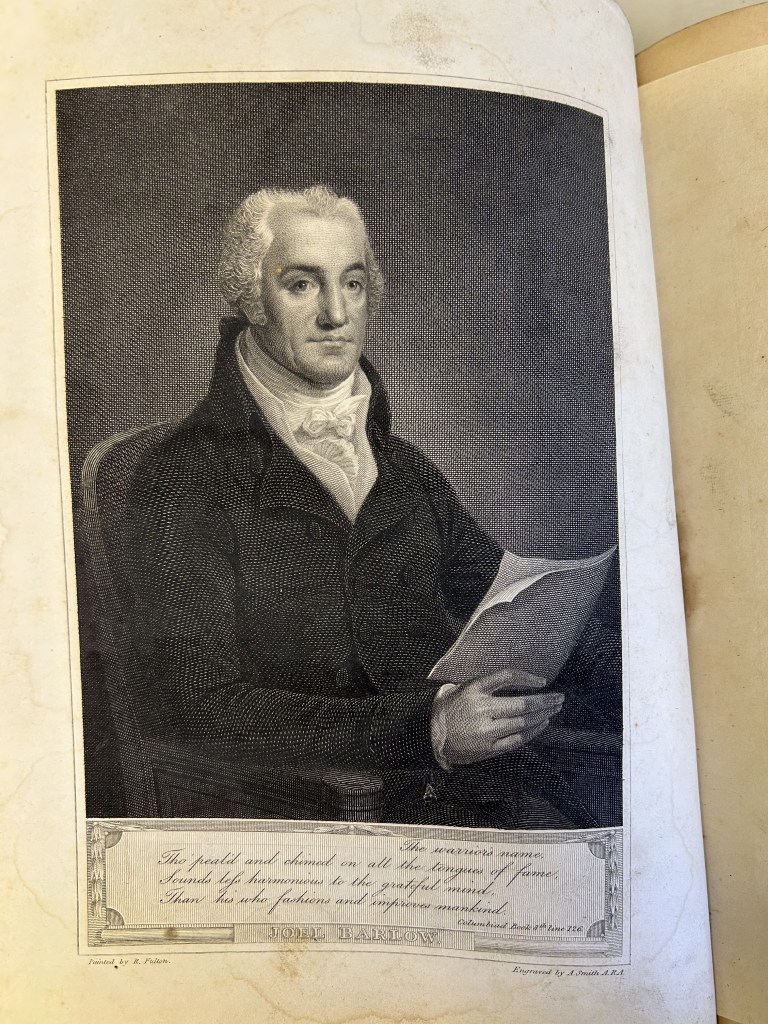
The name Columbiad frankly declares Barlow’s aspirations—to make an epic poem which glorifies America’s founding in the same ways which Virgil’s Aeneid glorified the founding of Rome, Homer’s Iliad glorified the ancient Greek city-state, or de Camões The Luciads glorified the Portuguese age of discovery. Although Barlow was the first writer bold enough to actually try and write it, the desire for a national epic was already present among the founding fathers. John Adams, after reading Ossian’s epic poem Fingal, wrote to John Trumbull, “I should hope to live to See, our young America in Possession of an Heroick Poem, equal to those the most esteemed in any Country.” Loyal readers of this series might have already drawn some of their own connections to James MacPherson’s works by “Ossian”, which I wrote about in my first entry to this series. Both works were born out of their authors’ desire to produce an epic (pseudo)historical poem which established and elevated their region’s culture. The Columbiad, however, is a lot more of a deliberate pastiche of the classical epic. Barlow uses the heroic couplet form, which was inseparable at the time from the most famous translations of classical epics from the 18th century (namely, Alexander Pope’s translations of the Iliad and Odyssey, and John Dryden’s of the Aeneid). In language, and often content, he deliberately imitates Homer, especially through the drawn-out grandeur of his battle scenes.
However, in the preface to The Columbiad, Barlow also is deeply critical of the classical epics. While the poetry may have been beautiful, Barlow believed that the moral conclusions of the poems were bankrupt because they praised conquest and affirmed the divine rights of kings. “The probability is, however astonishing [the works of Homer] are as monuments of human intellect, and how long soever they have been the subject of universal praise, they have unhappily done more harm than good.” So, in his ode to America, Barlow straddles the line between new and old, using classical style to try and tell a modern political history. Regardless of the quality of the poem, this is a fascinating and historically significant choice. Literature historian Roy Harvey Pearce wrote, “Barlow was not alone in his time in wanting an American epic. But he is the only poet (or would-be poet) before Whitman who had enough conviction and ability to run the risks involved in striving to use traditional means and forms to break away from tradition itself.” The question now is: Did he succeed in his efforts?
The content of the poem is certainly of interest for anyone invested in American history. When it comes to the revolution in particular, Barlow’s focus is minute and nearly comprehensive, spanning over three of the poem’s ten books. Representing Clermont, I’d be remiss if I didn’t mention the depiction of Richard Montgomery’s tragic death in Quebec—it’s rare to get the chance to see one of your historic site’s figures memorialized in heroic couplets, of all things. That being said, the actual quality of the poem, to me, is pretty uneven. The endless descriptive passages begin to weigh on a reader, and its lofty classical style aspires to far more than it achieves. Instead, the Columbiad shines as an example of an early experiment in American myth-making, a shaky attempt at an apotheosis of the historical figures which built this country, at making sense out of war and conquest.
To ennoble America, Joel Barlow often repurposed the truth of American history to suit his own political needs. A clear example is the text’s treatment of slavery. Barlow was an abolitionist through his entire career. In 1778, he published “The Prospect of Peace”, which imagined a future where “Afric’s unhappy children, now no more/Shall feel the cruel chains they felt before,/But every State in this just mean agree,/To bless mankind, and set th’ oppressed free.” In the Columbiad, he expands on the injustice of slavery in the one section of the poem which offers any criticism of his present-day United States. The Greek god Atlas (identified in classical mythology as a ruler of Africa) excoriates Americans for their hypocrisy, for fighting a war for the natural right to liberty while enslaving their fellow man. “Enslave my tribes! what, half mankind imban. / Then read, expound, enforce the rights of man! / Prove plain and clear how nature’s hand of old / Cast all men equal in her human mould! / Their fibres, feelings, reasoning powers the same. / Like wants await them, like desires inflame.”
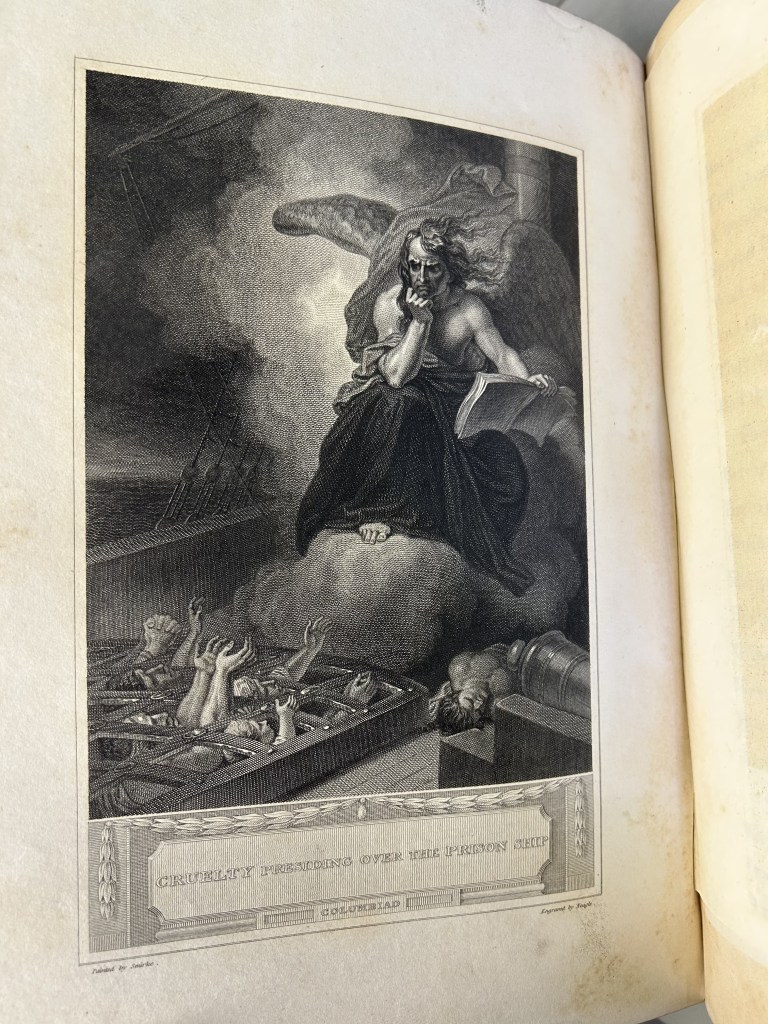
But this condemnation of present-day slavery did not mesh with Barlow’s sanitized version of American history. Since Barlow wanted to portray Columbus as the representation of fundamental American virtue, and slavery as an aberration, he neglected Columbus’ legacy as an enslaver. During his second voyage in 1495, Columbus enslaved 500 indigenous Taino people to be sold in Spain, of which 200 died in transit. Despite this, in The Columbiad’s introduction Barlow describes Columbus’ conduct with the natives as “prudent and humane,” and laments “Had his companions and successors… possessed the wisdom and humanity of this great discoverer, the benevolent mind would have had to experience no sensations of regret, in contemplating the extensive advantages arising to mankind from the discovery of America.” However critical Barlow is of slavery, in order to tell a positive nation-building myth, he felt he had to portray its foundation as pure, distorting the historic truth surrounding Columbus in the process. This is only one crucial example among many, most of which are errors of omission—Barlow made a panegyric to America which ignored anything that did not suit his aims.
So, we’re left with an epic poem which is unbelievable in its ambitions, unmemorable in its style, and perhaps unforgiveable in its distortions. But I think that as an artifact of the time, it is a fascinating look into how American writers and thinkers were beginning to conceptualize themselves and their history. Even today, writers who seek to use American history as a source must grapple with its realities to find truth, sense, and beauty. Great American poets whose works now easily eclipse Joel Barlow (T.S. Eliot or Walt Whitman come to mind) are still, in a way, indebted to his initial ambition. Roy Harvey Pearce called Columbiad “a prime exemplar of the first stage in the history of the American poet’s attempt to create that strange, amorphous, anomalous, self-contradictory thing, the American epic.” For that, the poem is worthy of remembrance.
Further Reading/Works Cited:
The Columbiad – full text available online at: https://www.gutenberg.org/files/8683/8683-h/8683-h.htm
Blakemore, Steven. Joel Barlow’s Columbiad, A Bicentennial Reading. Knoxville, TN: University of Tennessee Press, 2007.
Bidwell, John. “The Publication of Joel Barlow’s Columbiad,” American Antiquarian Society 93, no. 2 (October 1983): 337-380.
Botta, Enrico. “The Columbiad: Slavery, Imperialism and the Founding Fathers’ “State of Fantasy”” (2015): https://www.openstarts.units.it/server/api/core/bitstreams/7b2b55b9-fb26-414e-9130-7530bec5cf37/content


Leave a Reply