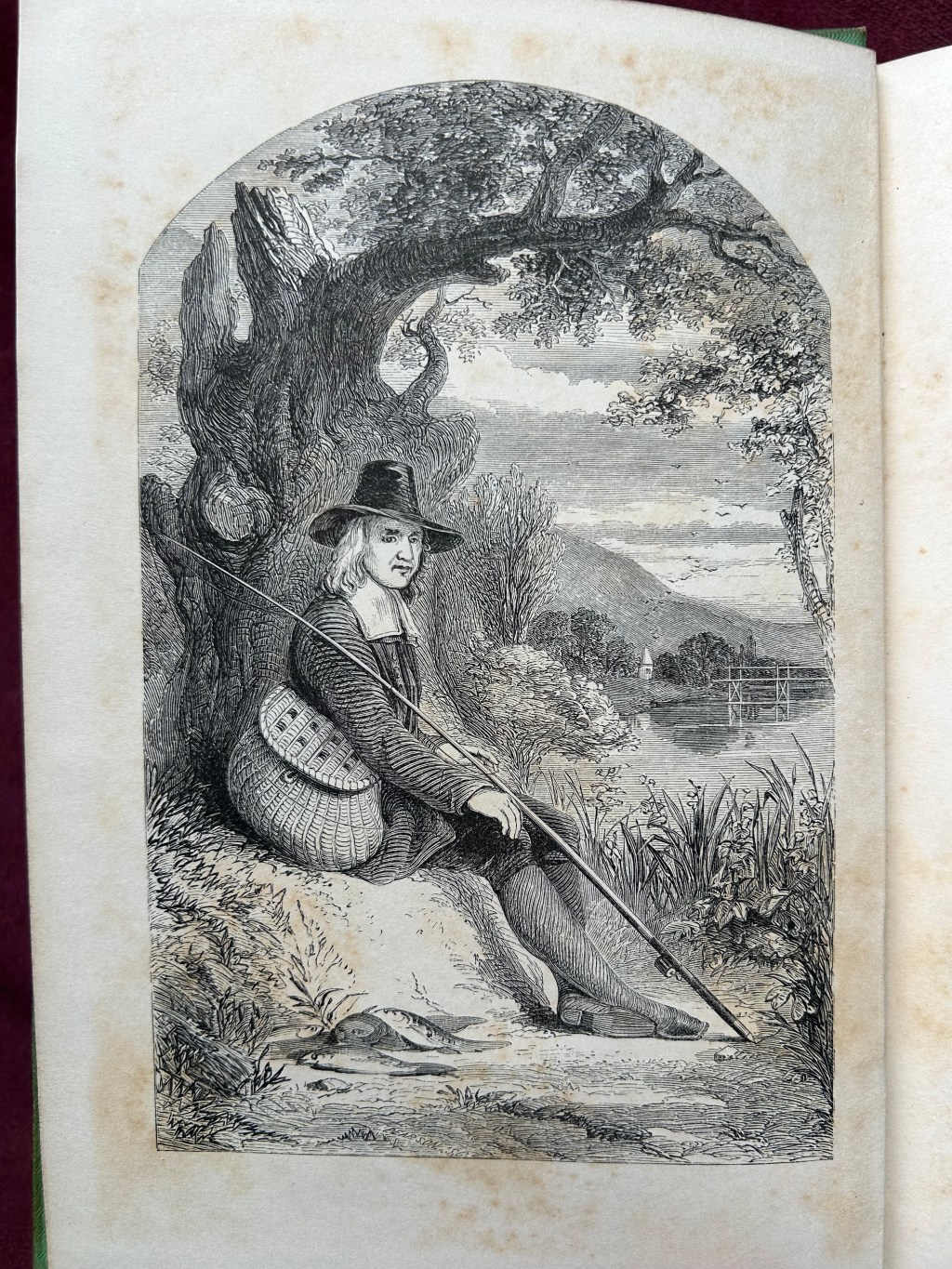

Hello again! Dawson Escott back with another installment of our series “On Clermont’s Shelves” where we highlight historically fascinating books in the Livingston family’s collection.
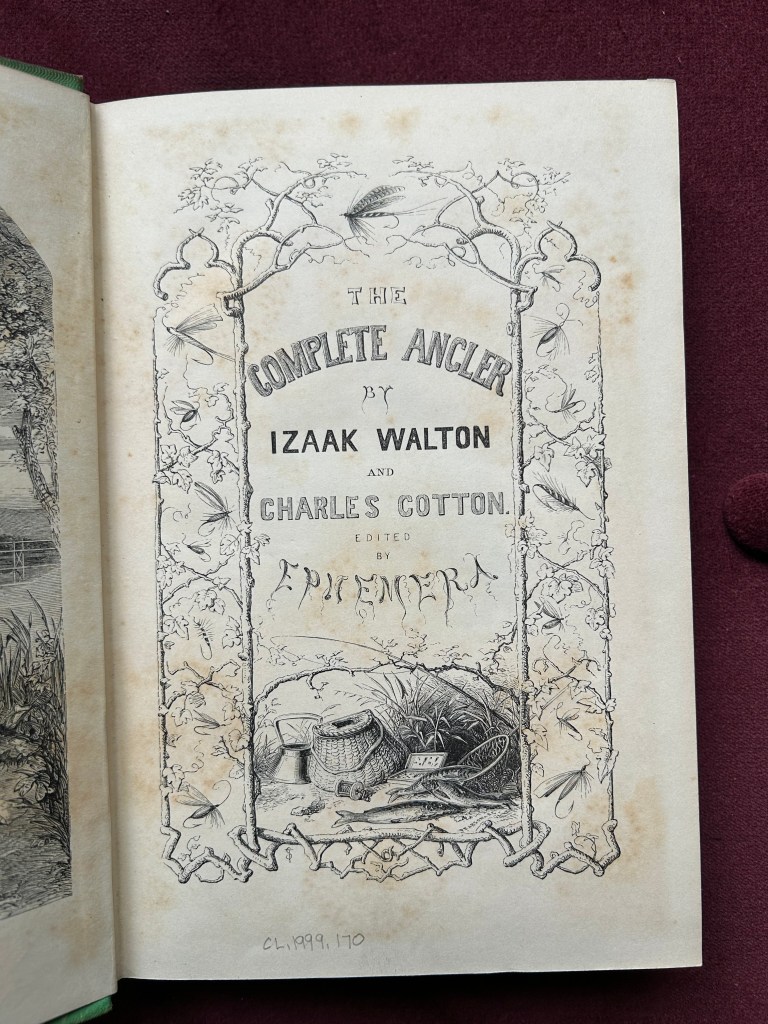
Unlike last week, there’s a chance you’ve heard of “The Compleat Angler”, especially if you’ve done much fly-fishing, but its popularity now pales in comparison with its historic fame. Since Izaak Walton published the book in 1653 — nearly 375 years ago, for those keeping count – it has never fallen out of circulation. Historian John R. Cooper counted no less than 284 editions in his 1968 study of the book, and modern editions continue to be released frequently. We even have two distinct editions released decades apart in our collection at Clermont.
Later editions do much to transform the original text into a practical guide for fishers, but the original format of the book is anything but simple nonfiction. The editor for our 1853 edition admits “it lacks the instructive element- it amuses more than it teaches”, but to my (admittedly non-fishing) eyes this is not a flaw of “The Compleat Angler,” but its most compelling feature. Most of the book is written as a dialogue between the characters Piscator and Venator (in Latin, literally Fisher and Hunter) where Piscator defends the virtues and pleasures of his craft to his skeptical peer. The tone is very down-to-earth and lightly humorous; think a field guide crossed with The Canterbury Tales. As the book proceeds, Piscator quotes great writers, weaves fables, and even bursts into song, all in praise of fishing. Walton’s style is more philosophical than naturalistic; fishing isn’t a mere hobby for him but a way of life which informs his worldview and character. The Pescator declaims “[A]ngling is somewhat like poetry… he that hopes to be a good angler, must not only bring an inquiring, searching, observing wit, but he must bring a large measure of hope, and patience, and a love and propensity to the art itself; but having once got and practiced it… it will prove to be like virtue, a reward to itself.” By the book’s close, Venator has been converted from a skeptical peer to an angling disciple eagerly receiving the Pescator’s wisdom, and you get the sense that Walton certainly hoped the reader has been converted just as totally.
When Izaak Walton wrote his fishing treatise in 1653, England was in an intense state of political turmoil. The monarchy had been overthrown by parliamentary rule, and King Charles I executed for high treason. A month before Angler’s publication, Oliver Cromwell dissolved Parliament by force, and soon after its publication he would assume the title of Lord Protector. Walton himself was a Royalist who had supported Charles I during the English civil war. When his political sympathies became a risk for him in urban society, he retreated to his family’s home in the English countryside. It was in this period of political seclusion that the seeds germinated for The Compleat Angler. Government officials who had been forced into retirement amid Cromwell’s upheavals suddenly found themselves in the countryside, uncertain of how to best occupy themselves. Walton’s book was in part popularized by this demographic, who took readily to fishing as a kind of spiritual remedy for the melancholy of exile.
Although he shies away from mentioning the present day or any political figures by name, his romanticization of meditative country life becomes all the more understandable against the backdrop of England’s chaotic political changes. The historical context slips through the cracks in the verses of “The Angler’s Wish,” one of Walton’s poems in the book: “Here, give my weary spirits rest/ And raise my low-pitched thoughts above/ Earth, or what poor mortals love:/ Thus, free from lawsuits and the noise/ Of princes’ courts, I would rejoice;” In the mid 19th century, as the Livingston family retreated from public political lives and began to embrace a more pastoral, farmer-aristocrat lifestyle at Clermont, it only makes sense that they would turn to Izaak Walton. The modern world (of 1653!) is brutish and harmful to the soul, but nature, the Angler argues, is an evergreen source of solace and immeasurable intrinsic beauty.
It’s because of his universal approach that over three centuries Walton’s book has always found an audience. Through his championing of a personal and spiritual contemplative connection to nature, Izaak Walton (reaching through the opaque fog of the 17th century) anticipates the philosophy of 19th American transcendentalists like Ralph Waldo Emerson or Henry David Thoreau, and (I would argue) even 20th century Beat generation poets like Gary Snyder and Philip Whalen. The Beat-adjacent poet Kenneth Rexroth describes Walton’s writing through this spiritual lens:
“We do not read The Compleat Angler for the fish, or for instruction in how to catch them. There are hundreds of more efficient books for such purposes, whether manuals or ichthyologies. We read Izaak Walton for a special quality of soul. Other books, mostly religious or mystical treatises, may describe such a quality and may even provide the reader with onerous instructions on how to obtain it. Walton simply embodies it unaware, and his example is possibly the most convincing argument that this is the only way it can be embodied.”
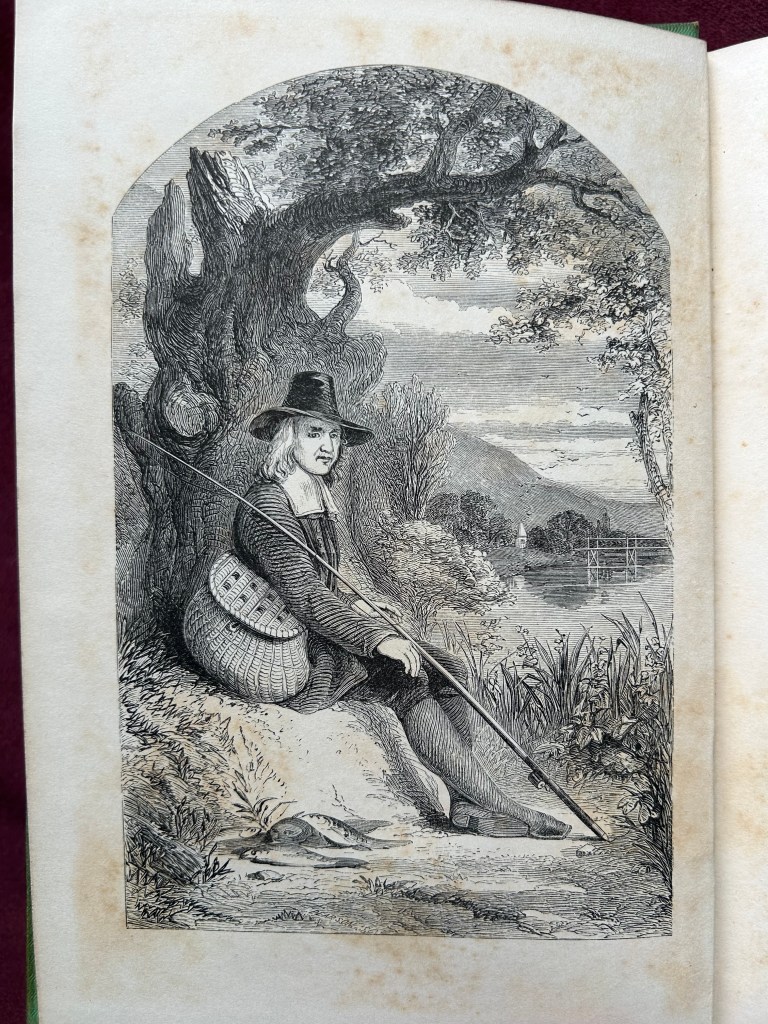
The Compleat Angler still is very charming to read. Even in an old English style it remains very readable and beautifully simple in its language. For those who fish, I’m sure the book’s message resonates even more strongly and what was true of the beauty of the sport then remains true now. For those like me who have never picked up a fishing rod, it can still help one to consider the beauty of a riverbank, and the consolation that the natural world can always so readily provide.
Hewett, Taylor. “Moral Philosophy and the Dialogic Tradition: Izaak Walton’s The Complete Angler.” PIT Journal (2010). Moral Philosophy and the Dialogic Tradition: Izaak Walton’s The Complete Angler – PIT Journal
Rexroth, Kenneth. Classics Revisited. New Directions, 1986. Walton, Izaak, and Charles Cotton, The Complete Angler. George Routledge and Sons. 1853. https://catalog.hathitrust.org/Record/102713105
 Clermont State Historic Site
Leave a comment