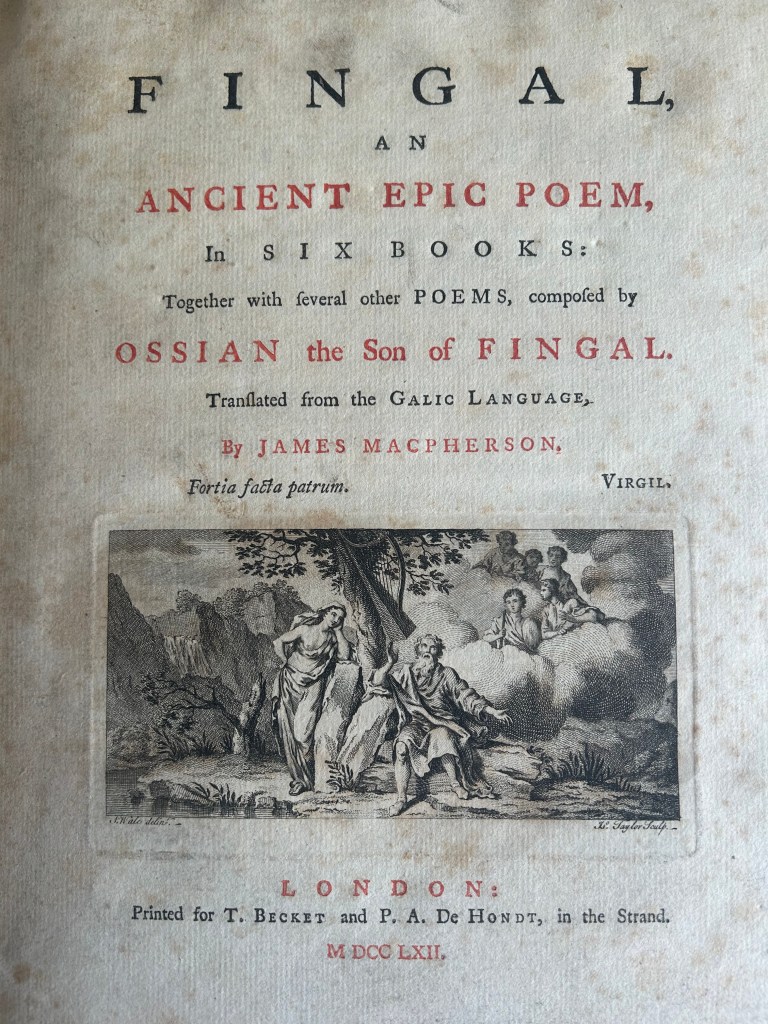
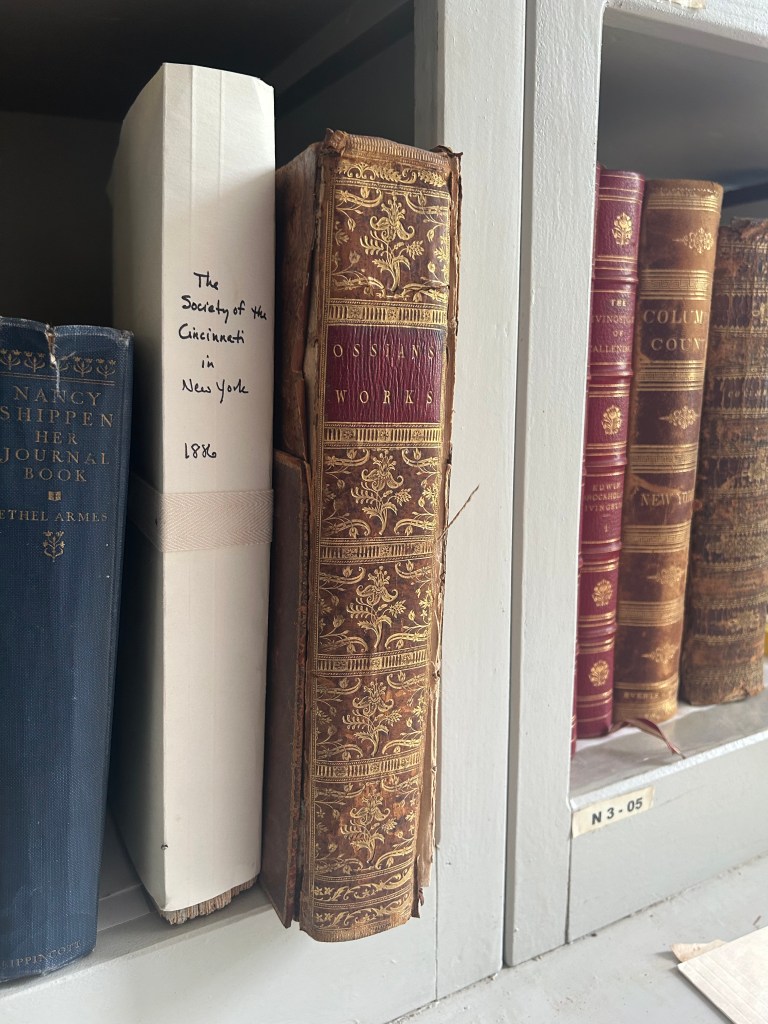
Hello! My name’s Dawson Escott and I’m currently the Curatorial Assistant at Clermont. I wanted to do a small series on here highlighting some unique and lesser-known books I’ve stumbled upon at our historic site while doing objects research. Clermont is home to a book collection spanning seven generations of shifting taste, so I’m sure I’ll have plenty of interesting material in the weeks to come.
On the shelves of Clermont’s libraries, it’s not hard to find well-known, classic books that have heartily withstood the test of time—Shakespeare’s plays, say, or a collection of Edgar Allen Poe’s stories. Almost as typical are books that were uncommon then and obscure now. But once in a while, if you’re lucky, you’ll stumble upon a book that likely nobody you ever know has heard of but was once massively popular. Our item of discussion today wasn’t just popular in terms of sales. Decades after publication, the author of this book was still considered a clear candidate for the great pantheon of epic poets; some even accorded him equal status alongside Dante, Virgil, and Homer. But how many of us today have heard of Ossian?
When “Fingal, an Ancient Epic Poem in Six Books” was published in the 1760s, it was amid the active decline and destruction of Gaelic culture in the Scottish Highlands. After the failed Jacobite uprising of 1745, the English government took extensive measures to assimilate the culture of the Highlands and weaken their capacity for revolt. Within their lifetimes, residents in the Highlands saw their traditional way of life seriously endangered—the judicial rights of clan lords were abolished, the owning or bearing of weapons (including bagpipes) was outlawed, and most famously, it became illegal to wear “Highland dress,” including the kilt and tartan. These oppressive political threats to Gaelic culture were enacted in the context of a wider socioeconomic decline in the Highlands as the agricultural and economic models on which the clan system was dependent became untenable.
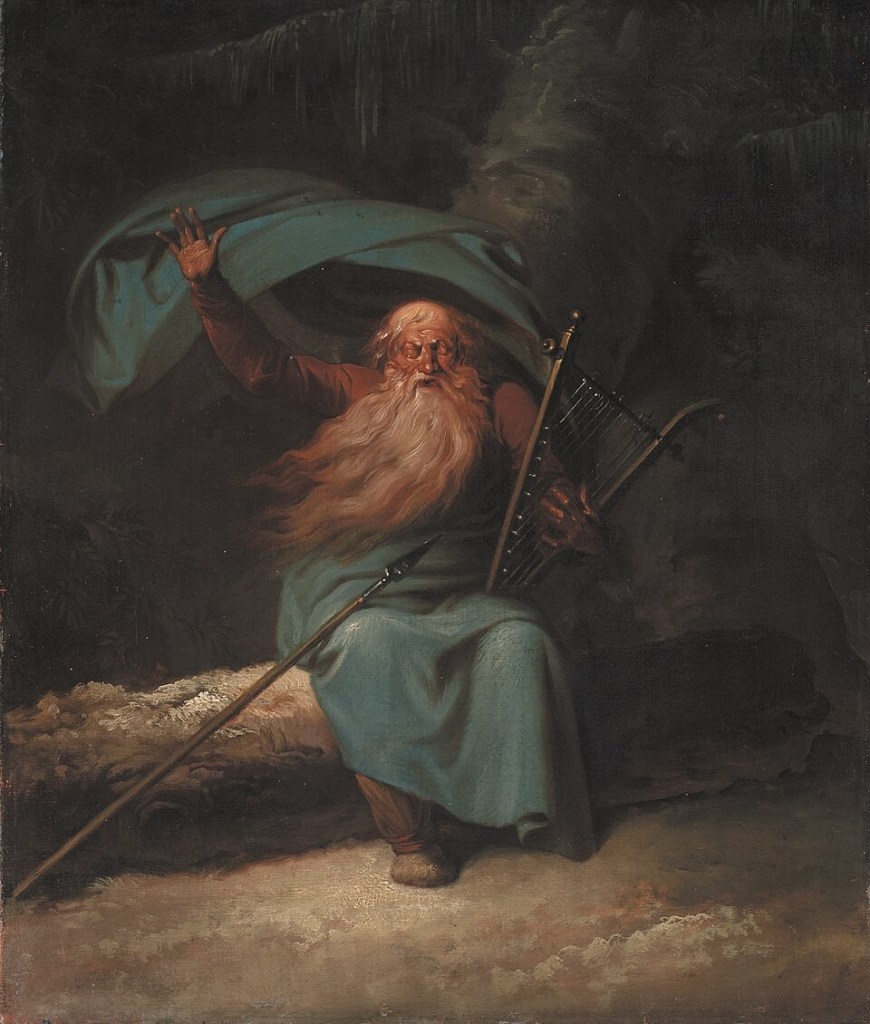
For our purposes today, the most significant threatened element of Gaelic culture was its bardic tradition. Bards in each community recited their people’s myths and histories and passed down their role hereditarily across centuries worth of generations. In 1760, Scotsman James MacPherson, a speaker and scholar of Gaelic, published “Fragments of Ancient Poetry collected in the Highlands of Scotland,” poems he had translated from rare Gaelic manuscripts which fortunately preserved the endangered bardic oral tradition. These fragments had immense commercial success, after which MacPherson released multiple, far more complete, epic poems. These newly published poems, MacPherson argued, were the work of one great bard of the, found extant across multiple manuscripts and now reassembled for the first time since antiquity. Finally all together again, Ossian, a voice for the ancient Scots just as Homer was for the Greeks, rose to the international stage.
Ossian captivated many figures of the era. Henry David Thoreau called his poetry “of the same stamp as the Iliad,” and Napoleon reportedly had a copy with him for all his military campaigns. Further, the next generation of Romantic writers took great inspiration from the melodramatic Gothic atmosphere of Fingal and it ultimately played a major (and now rarely acknowledged) role in the history of Western literature. Interestingly, Thomas Jefferson was a huge fan of Ossian, going so far as to say, “I am not ashamed to own that I think this rude bard of the North the greatest Poet that has ever existed.” It was perhaps through his friendship with Thomas Jefferson that Robert R. Livingston first heard of Ossian and acquired the copy of Fingal in our collection. As a Scotsman himself, he may have even felt a personal investment in the role Ossian’s poetry played in the rediscovery and newfound appreciation of Gaelic culture.
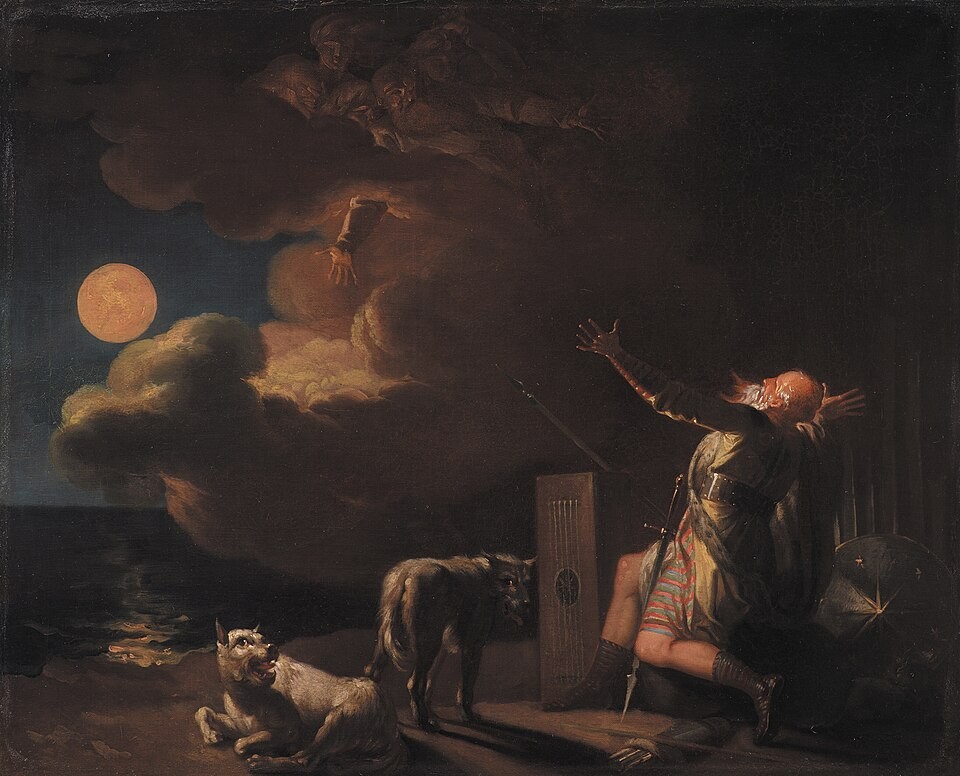
But here’s the twist, and the probable reason why you haven’t heard of this great Gaelic bard: the “translator” James MacPherson very likely wrote the whole thing himself. Although many of the stories which comprise the plot of Fingal existed in one form or another from which MacPherson drew inspiration, the actual poetry is almost entirely his own. From the moment of its publication, Fingal attracted scrutiny, especially since MacPherson refused to allow anyone to see the original Gaelic text and verify its authenticity. Perhaps the most renowned of these critics, Samuel Johnson, wrote “I believe they never existed in any other form than that which we have seen… It would be easy to shew if he had it; but whence could it be had?” Equally, the work attracted defenders of its authenticity, appreciators of the beauty of Gaelic culture who wanted it to be real so badly that they found whatever scholarly justification they could to keep its myth alive.
As far as literary forgeries go, MacPherson’s work is impressive. Beyond just imitating the rhythms of classical poetry, he also imitates the dusty scholastic voice of an 18th century translation. For the modern reader, there might be more amusement to be found in MacPherson’s countless editor’s and translator’s notes than there often is in the poem itself. Cleverly, MacPherson’s Fingal is a prose translation, eschewing the “original” poetic verse form. For authentic translations, this technique is often employed to preserve fidelity to the literal meaning of the original text, but often at the cost of some of the poem’s beauty.
For MacPherson, this choice helped to defend the realism of his forgery through an added layer of pseudo-scholarship. It also reinforces a critical theme of the text– the lost beauty of the bygone Highland culture, now only accessible through the fragmented remains of translation. For contemporary readers, the imagined real Gaelic version of Fingal was the one that they appreciated. Ossian fans had faith that whatever flaws were present in the work as they had it were only the weakness of translation. This is why Thomas Jefferson wrote to MacPherson’s brother-in-law, begging for the (nonexistent) original Gaelic version, “desirous of learning the language in which Ossian thought, in which he sung.”
MacPherson’s narrator, Ossian, old and blind, recounts a culture soon to disappear forever. His father Fingal, whose deeds the poem recounts, has died. The poet’s son, Oscar, has died too. There is nobody to whom he can pass on his poetry, so he sings into the wind. “My voice remains, like a blast, that roars, lonely, on a sea-surrounded rock, after the winds are laid.” Knowing that Fingal was a forgery, it’s clear that this poem was written when Gaelic culture was at risk of being permanently forgotten—when poets like MacPherson felt that their ancestors sung into the wind, that a work like Fingal must have existed but had already been lost. To MacPherson, even if Ossian didn’t exist, he should have, and someone ought to invent him. Ossian fulfilled the need of Scottish readers like Robert R. Livingston to gain access to their endangered cultural heritage. The controversy surrounding the authenticity of the poem lasted half a century, but when the tide of critical opinion turned and it was widely agreed that MacPherson had misrepresented the nature of his writing, the popular appeal of Ossian quickly dried up. If it was never real, what’s the point?
Gaskill, Howard. “The Reception of Ossian in Europe.” Bloomsbury Academic (2004).
Moulton, Paul F. “A Controversy Discarded and ‘Ossian’ Revealed: An Argument for a Renewed Consideration of ‘The Poems of Ossian.’” College Music Symposium 49/50 (2009): 392–401. http://www.jstor.org.wikipedialibrary.idm.oclc.org/stable/41225266.
Murphy, Peter T. “Fool’s Gold: The Highland Treasures of MacPherson’s Ossian.” ELH 53, no. 3 (1986): 567–91. https://doi-org.wikipedialibrary.idm.oclc.org/10.2307/2873040.

 Clermont State Historic Site
Leave a comment