 Forks and knives and spoons–oh my!! From the first time I saw the movie \”Pretty Woman,\” I knew that a formally-set table was something intimidating. You use what, when? In the movie, there\’s something in there about counting tines on the forks, and then the tutor in the scene breaks down and advises Julia Roberts to just \”work from the outside in.\” Then I went graduate school and was given the additional advice to hesitate and watch what other people were doing (hopefully inconspicuously). Even a young George Washington was concerned with this issue when he copied out dining rules from 100-year-old etiquette manuals. It\’s an old story: how does the upwardly-mobile, but socially ignorant diner fit into a high-society dinner?
 But what about the upwardly-mobile hostess? The presentation of that intimidating dinner table was something that required equal or greater effort than just selecting a fork. How many forks were suposed to go there in the first place? Centerpieces aside, the question is, \”where does all that silverwear go?\” (It is worth adding here that servants, especially butlers, were the ones asking this question in some time periods and social circles).
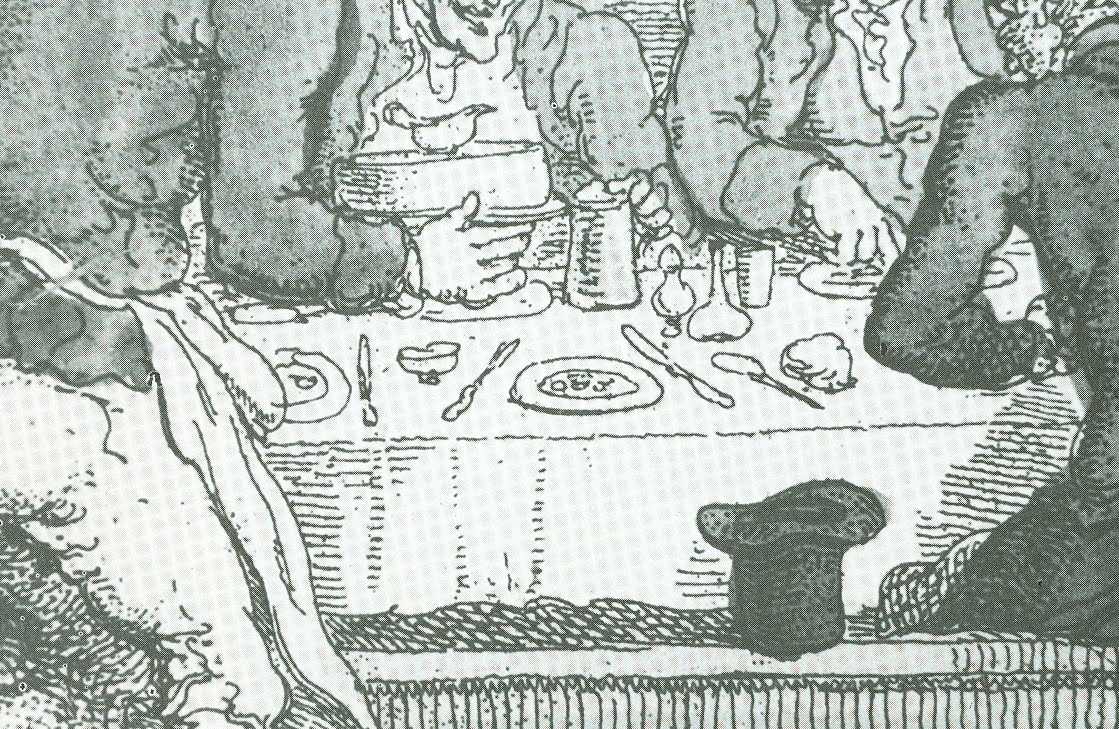 Things started developing into a pretty recognizable form by the beginning of the 18th century, when forks were making it onto the scene and napkins were increasing in popularity and availability. Early on in the process, the stalwart dinner fork got put on the left side and staid there. Bless its little heart. You can always count on the dinner fork. You can see it at left even in the Thomas Rowlandson satirical cartoon of 1788. The fellows in the picture may look like uncultured slobs, but at least they know where the dinner fork goes.
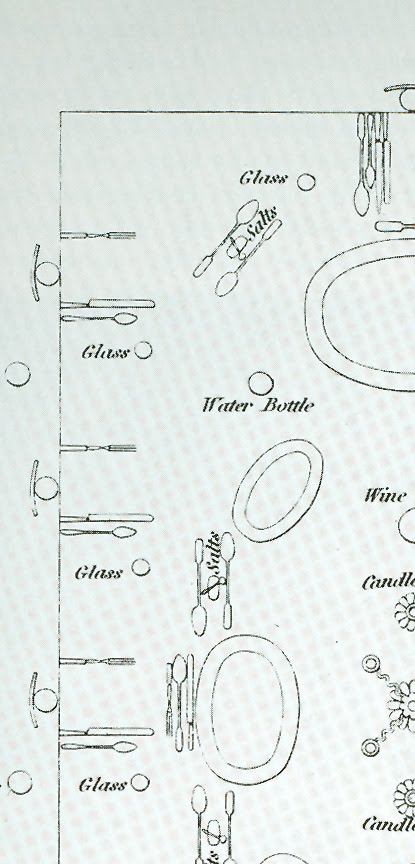
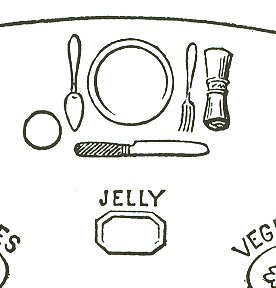
  But then the dinner fork had children. Many of them. Their names were Shrimp, Oyster, Pickle, Salad, Fish, Pastry, and Dessert (1935 illustration at right). And there were more too, but we can only follow so many of Fork\’s offspring. In the 18th century and early nineteenth century, it was the proliferation of dishes that made a meal notable. According to Festive Tradition, \”…it might take several servants up to twenty minutes to carry in all the dishes to the the table.\” With meals served in only two or three courses, and different forks for each food, you couldn\’t really \”work from the outside in.\” Knowing the use of each fork was a bit tougher, perhaps with the exception of dessert forks, which showed up alone at the end of the meal.
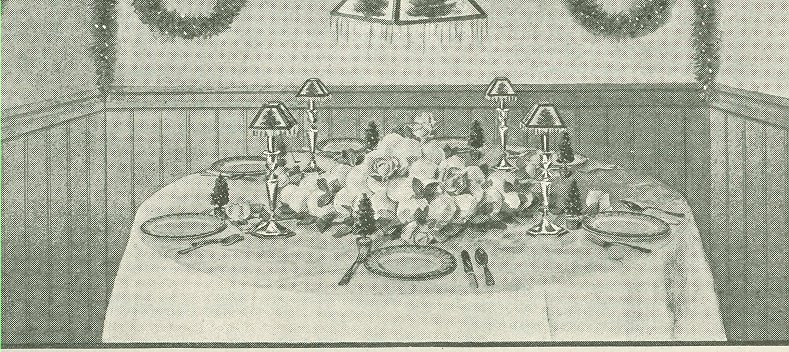 Thankfully for everyone, in the 20th century, we got a little bit more casual about our dining, and the number of forks on most fancy tables decreased. Even a 1906 Christmas table set on the right shows only one fork. Ladies Home Journal apparently let you off easy.
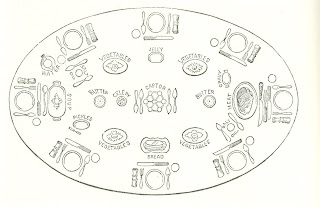
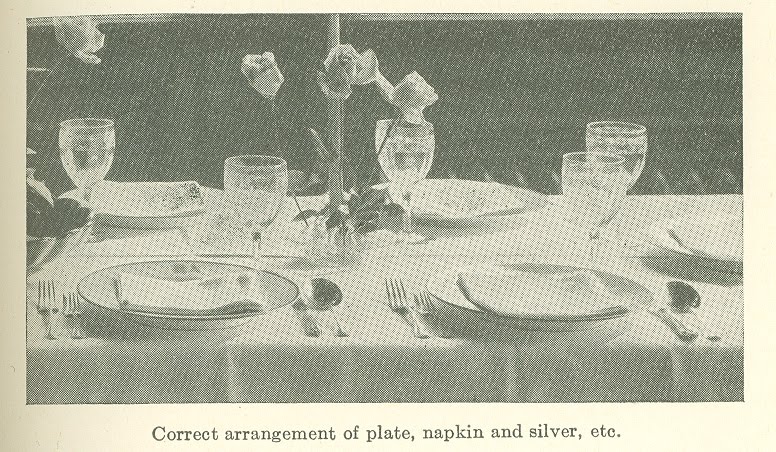
  See above photograph for a departure from this from Alice Livingston\’s 1935 copy of Table Service and Decoration. At left you can see an image a formal table from the same book however which shows only four forks, neatly arranged in order of use. Don\’t miss that wiley shrimp fork on the right. It can\’t be trusted; it moves around.
 What about the Knife? It seems trustworthy enough. Predating the fork, this old codger was once used as the major dining implement of the well-bred. You stabbed your food with the tip of it and gently brought it to your mouth that way. There it is in an 1825 instructional illustration on the left. You\’ll notice that the blade points in. This is important. You can also see the blade pointing in on the Thomas Rowlandson image from 1788 and the 1935 photograph above. It is as constant as the Northern Star. Knife could even show up on the dessert table as shown in the 18th century image below (with the spoons).
  Even when the knife was not in its usual place to the right of the plate (as shown in the 1860s Godey\’s Ladies Book image at right), the blade pointed toward the plate.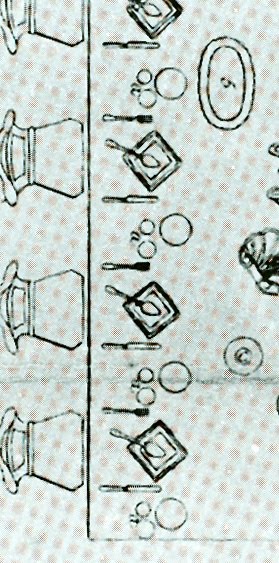
Serving spoons of various sizes could be found all around the table in the serving dishes of course. Salt spoons could also be found on the 18th century table before salt began to be served in shakers. Several salt cellars, adorned with their own spoons would be located around the elgant table to make it easy for each diner to reach this expensive flavoring. But the soup spoon was a bit of a migrant. It could sit still further to the right or it could travel up above the plate and lie paralell to the edge of the table. Still worse was the Dessert Spoon who came out with the elite dessert team and could sometimes be found at a hazardous diagonal orientation (seen at left). By 1935 Alice\’s Table Service book also describes tea spoons, iced tea spoons, jelly spoons, 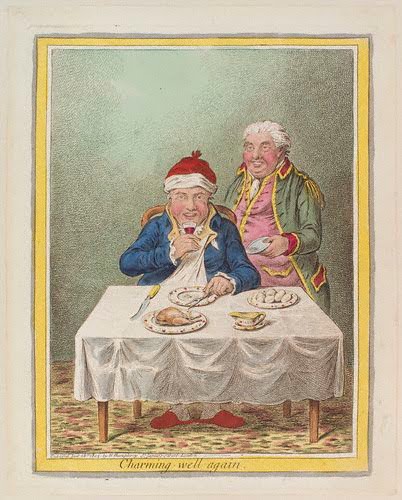 olive spoons, orange spoons, ice cream spoons (with tines like a spork) and the 5 o\’clock tea spoon (very closely resembling the cereal spoon).
 The Napkin stared its life pressed to have sharp square fold that would match similar folds on the table cloth. Later, it could be dressed up with a silver napkin ring starting in the 19th century, as seen in this detail of the 1860s Godey\’s image. At various times, the Napkin could conceal a hot dinner roll,
 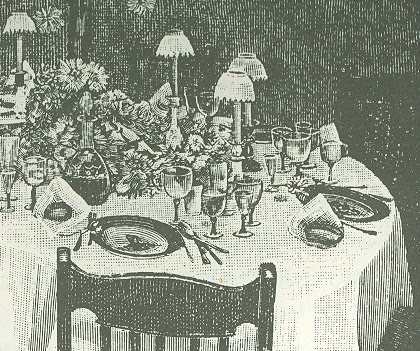 as seen at right in this late 19th century illustration.
Most flamboyantly, the napkin could become a sculpture folded artfully on each diner\’s plate, as seen in the 1891 image at left. It continues to hang out on the plate in this manner at many fancy meals today. Folding instructions of all sorts are written down, shared, or kept secret as needed. Still on its humblest days, the napkin returns to basic folds beside or underneath the fork or even resting peacefully on the plate.
 Indeed it seems that the only constant in this whole place-setting debacle is the Plate. It waits right in the middle of the party every time, just waiting for its helping of meat and potatoes. Sometimes it shares with a bread plate. Other times it patiently waits under a soup bowl. But it never wanders, and we are never left looking for it. Even the freshest hostess need never fear the placement of the Plate.
 Clermont State Historic Site
Leave a reply to Anonymous Cancel reply