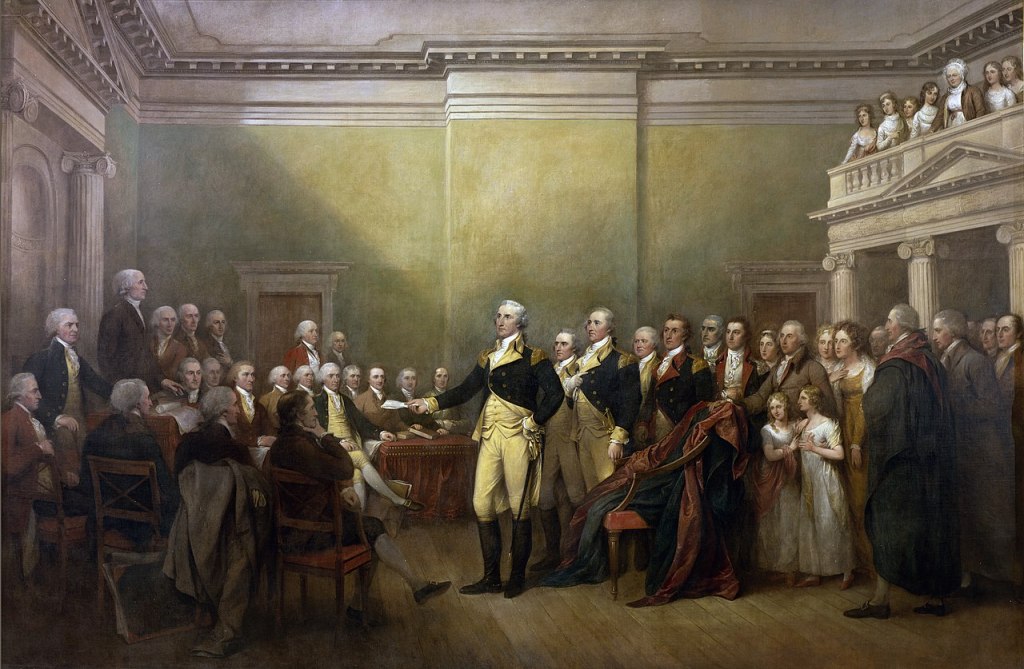
George Washington and Martha Washington visited Clermont in the summer of 1783. George was on his way to visit the northern theater of the war and Martha would be staying with Margaret Beekman Livingston while George was in the north. When this incident is talked about at the site it is told as “George and Martha Washington visited Clermont.” Of course, George and Martha did not visit alone.


First off Martha would have traveled with a retinue of enslaved women who would have tended to her clothing and other baggage, helped her dress and undress, and a full slate of other duties. These people would have stayed in the basement with Margaret Beekman Livingston’s enslaved people, although it wasn’t uncommon at the time for a slave master to have an enslaved person sleep near their bed to address any needs they had during the night.
As far as George Washington was concerned the necessities of war meant that usually travelled with just one enslaved man, William Lee. Lee was not only responsible for the General’s clothing and hygiene and for organizing Washington’s papers but was expected to attend to the General during battles, holding his telescope and delivering messages. Lee was known to be an excellent horseman.

Lee had been purchased by Washington in 1768 for £61.15. He was described as mulatto most likely meaning that the man who owned his mother had raped her and William was the result. Lee served Washington for the rest of Washington’s life and was the only enslaved person immediately freed by Washington’s will. Lee remained at Mount Vernon though and was something of a celebrity there. Tourists would sometimes come to stare at him. He was married to a free woman from Philadelphia named Margaret Thomas but there is no evidence that she ever resided at Mount Vernon with him. When William died in 1810, he was most likely buried in an unmarked grave in the enslaved cemetery on the estate. [i]
Washington, being the most important man in America at that point, would have been accompanied by a guard to deter any attempts on his life. In early June of 1783 Washington’s Life Guard, who had accompanied him throughout the war was furloughed as the war wound down. By the time he visited Clermont his guard was made up of soldiers selected from the regiments encamped at New Windsor[ii] under the command of Captain Bezaleel Howe. Howe and most of the guard would have traveled north with Washington, but a few soldiers were most likely left at Clermont to guard Martha.
Bezaleel Howe was a native of Marlborough, Massachusetts who had been sent to New Hampshire to be raised by relatives at a very early age. He fought in the war since the Battle of Bunker Hill. He was present at Fraunces’ Tavern in December 1783, when Washington bid farewell to his officers. Howe escorted Washington’s baggage to Mount Vernon and then returned to New York. After a brief sojourn in New Orleans Howe remained in New York for the rest of his life, passing away in 1825.[iii]

In addition to William Lee and his personal guard Washington would also have been accompanied by at least some of his military family. Washington was still in command of the army even though it was drawing down in size and he was traveling away from it. He still had to issue orders, receive, and send correspondence, and he could not do all that work alone.
At the time of his trip to Clermont Washington’s military secretary was Jonathan Trumbull Jr. Trumbull should not be confused with his younger brother John who was a famous artist. Trumbull was a 33-year-old Harvard graduate, who had joined the army in 1775. He served as paymaster to the Northern Department before joining Washington’s staff. After the war Trumbull served Connecticut, his home state, as a congressman, senator, and governor from 1797 though 1809 when he died in office.

At the time of the Washingtons’ visit to Clermont George had five aids-de-camp. They were Hoydijah Baylies, Dr. David Cobb, David Humphreys, Richard Varick, and Benjamin Walker.
Hoydijah Baylies was a Harvard graduate. He had previously served as an aid-de-camp to General Benjamin Lincoln. He was captured with Lincoln in the fall of Charleston but later exchanged. After the war he held several political offices in Bristol County, Massachusetts, the last being Judge of Probate. He died in 1843.
Dr. David Cobb was also a Harvard graduate. He studied to become a physician after his graduation. He served in the army beginning in 1775 and remained on Washington’s staff until the army was disbanded in December of 1783. After the war he held many political offices and was also major general of the Massachusetts militia during Shays’ Rebellion. He eventually rose to congressman. Cobb then moved to Maine and held several more offices there. He died in 1830.

David Humphreys was from Connecticut and a graduate of Yale. Before the war he worked as a private tutor for the children of noted loyalist Frederick Philipse.[iv] Humphreys enlisted in the army in 1776 and served on the staffs of General Israel Putnam and Nathanael Greene before joining Washington’s staff. Humphreys was one of two aids that accompanied Washington to see congress and resign his commission. After the war Humphreys served as secretary to Benjamin Franklin. Humphreys would then return to work as Washington’s secretary, even standing on the balcony of Federal Hall as Chancellor Robert R. Livingston swore George Washington into office as President. Humphreys also claimed to have imported the first Merino sheep to America although Livingston was actually the first. Humphreys died in Connecticut in 1818.


Richard Varick was from New Jersey and attended King’s College although he never graduated. He joined the army in June of 1775 and was named secretary to General Philip Schuyler. Varick became a member of General Benedict Arnold’s inner circle but was never an official member of his staff. He supported Arnold in his dispute with General Horatio Gates during the Saratoga Campaign. After Arnold’s treason Varick was assigned to transcribe Washington’s papers in part to help rehabilitate his reputation. This work became known as the Varick Transcripts. After the war Varick held several political positions in New York including serving as Mayor of New York City from 1789-1801. After his stint in New York, Varick helped to found Jersey City, New Jersey before he died in 1831.

Benjamin Walker was born in England, spent some time in France and finally immigrated to the American colonies. Walker joined the army and was appointed aid-de-camp to Baron Friedrich Wilhelm von Steuben. Walker used his skills in the French language to translate what the Baron was saying to the troops. During his time with the Baron, Walker and von Steuben developed a romantic relationship which continued after the war even after Walker married. He was named an heir to von Steuben in his will. After Walker was transferred to Washington’s staff, he was the other aid to accompany Washington to congress when he resigned his commission. After the war Walker moved to Utica, New York and served one term in congress. He died in 1818.

Taking all of this into consideration the visit from George and Martha Washington was far more than a simple visit from George and Martha Washington. Enslaved people, guards, secretaries, aids and their servants and enslaved people, would have brought the total number of visitors possibly as high as fifty people. For someone who had not quite finished having her house rebuilt, this visit would have required a major effort and expenditure from Margaret Beekman Livingston. But of course, she did it. Her station in life, her dignity and her honor would require nothing less of her. Besides, who would turn down an opportunity to be able to say, “Washington slept here.”
[i] https://www.mountvernon.org/library/digitalhistory/digital-encyclopedia/article/william-billy-lee/
[ii] The site of this encampment is now a state historic site https://parks.ny.gov/historic-sites/newwindsor/maps.aspx
[iii] https://www.socnh.org/bezaleel-howe/
[iv] Philipse Manor Hall is now a state historic site https://parks.ny.gov/historic-sites/philipsemanorhall/
 Clermont State Historic Site
Leave a comment