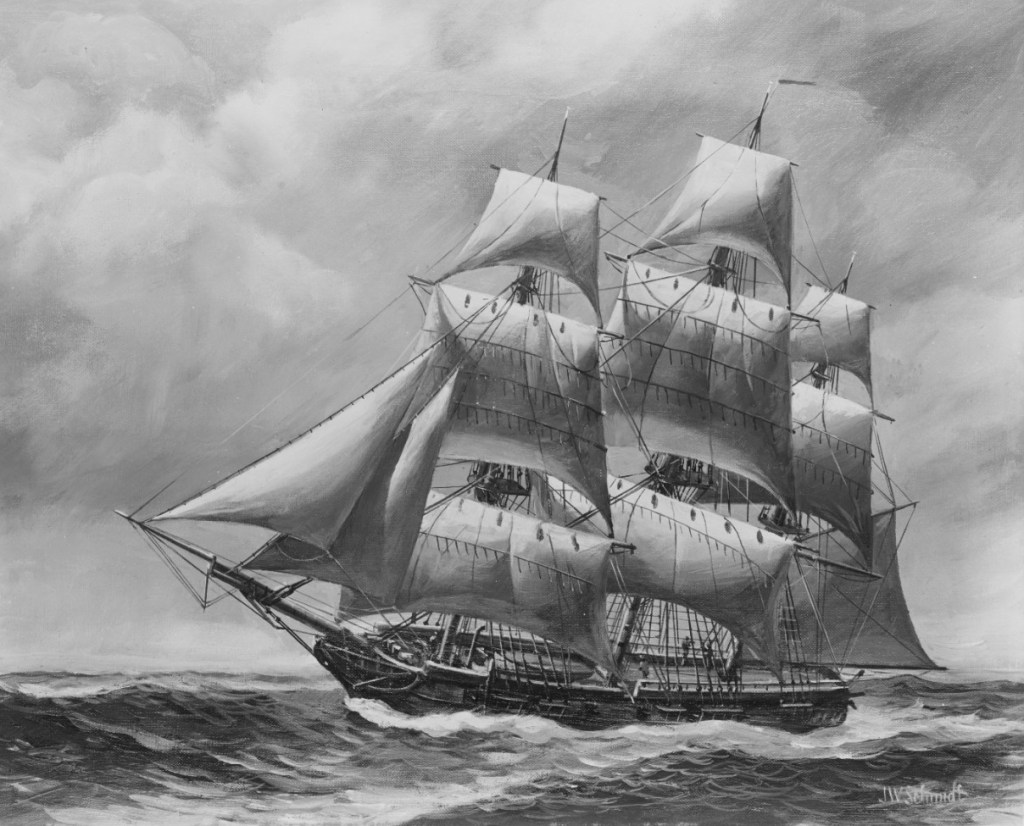
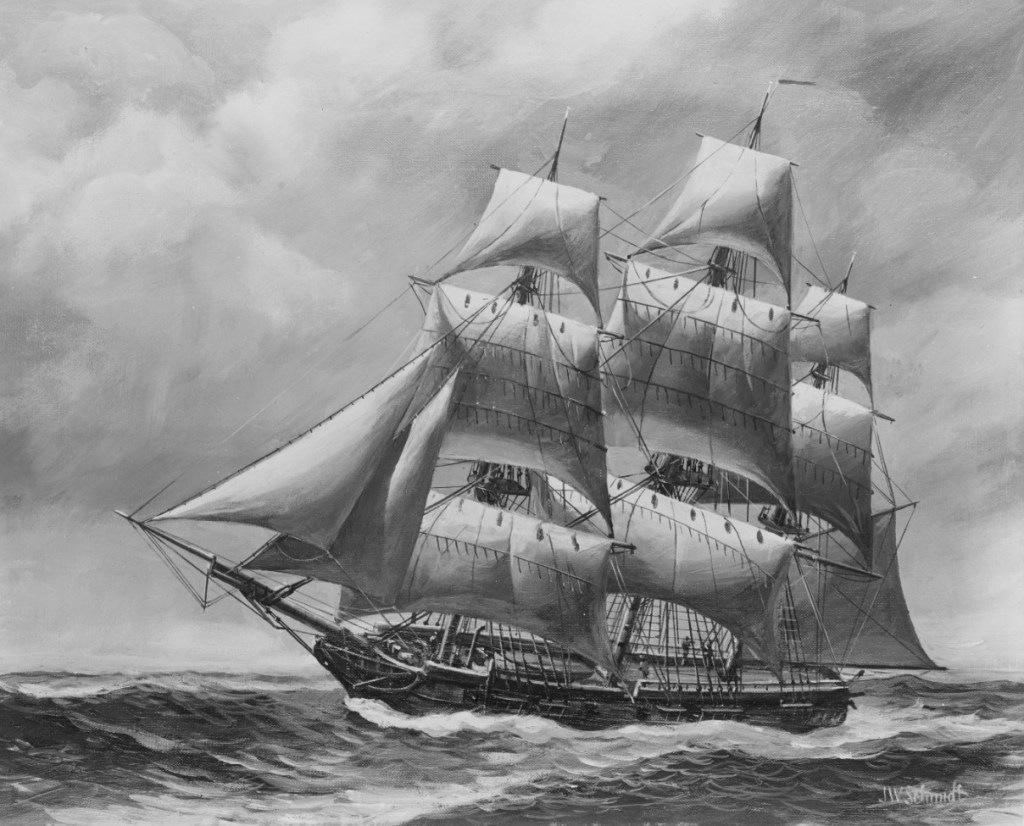
On August 13, 1780, the American Sloop Saratoga put to sea, the first ship named after the stunning American victory that helped to change the tide of the war. The ship was 68 feet long at the keel and 25 feet wide. She was rated at 150 tons. She carried 18 guns, 16 nine pounders that fired 9-pound cannon balls and two four pounders that fired four-pound cannon balls. This gave her a broadside of 76 pounds. She carried a crew of 86 men under the command of Captain John Young.
Among her crew was John Lawrence Livingston. John was the son of William Livingston, who was a prominent patriot and New Jersey’s governor. John was born in 1762 making him only 18 or 19 when the ship sailed. John Lawrence served as a midshipman, an officer in training, aboard Saratoga.[i]
The Saratoga’s first mission was to escort the packet Mercury, carrying Henry Laurens to Europe. The Saratoga was poorly ballasted which made her slow and unsteady. Tired of the delays caused by the sloop, Laurens released the ship from its escort duties. The unescorted Mercury and Henry Laurens were soon captured near Newfoundland by the Royal Navy.
Meanwhile, Captain Young took the opportunity to train his men on handling and fighting the ship. About two weeks later they encountered the British ship Keppel. They fought a three-hour battle that ultimately proved inconclusive when deteriorating weather forced the ships to break off. Three days later Saratoga came across a British merchant ship loaded with rum and quickly captured her. Both ships sailed into Chester, Pennsylvania.
After three days of restocking supplies and reballasting the ship Saratoga put to sea again. After a week she captured the brig Elizabeth which was an American ship that had been captured earlier. Soon there after two sets of sails were spotted and Captain Young gave chase. He brazenly ordered the helmsman to take Saratoga in between the two ships. He ordered the larger ship Charming Molly to surrender. When they refused, he fired a broadside into the ship then sent a boarding party to capture the ship, which they did after fierce hand to hand fighting. Seeing this, the second ship Two Brothers, surrendered without a fight.
From the captain of the Charming Nancy Captain Young learned of three more British ships in the area. He soon found them. Once again passing between the ships, Saratoga, fired broadsides from both sides of the ship, and disabled two of the British vessels. The third escaped.
The next morning an American ship that had been captured by the British was spotted, as was a British ship-of-the-line carrying 74 guns. Any captain of a small sloop would have been in their rights to turn and run. Instead, Saratoga swooped in and rescued the American ship nearly from under the guns of the 74, from which one broadside would have turned Saratoga into nothing but driftwood.
After two months of refitting in Philadelphia Saratoga headed toward the Caribbean, escorting a dozen merchant vessels and with a mission to carry French supplies back to America. Within days she had captured a British privateer sniffing around the convoy. On January 9, 1781, Saratoga captured another privateer and a week later an armed brig. On the 27th of January they reached their destination and turned their prizes over to the French.
While waiting for the French supplies that they were to carry to be ready Saratoga joined a small fleet of American and French vessels in a cruise of the Caribbean. After 8 days they returned with one British ship as their prize.
On March 15 a massive convoy of American vessels, including the Saratoga, French warships and twenty-nine merchant vessels left Cap Francis bound for America. On March 18 Saratoga broke off from the convoy to chase two enemy sails that had been spotted. In the mid-afternoon she caught up with the first ship which surrendered without a fight. Captain Young hastily put a prize crew aboard and sailed off after the second ship. Midshipman Penfield, in command of the prize crew attempted to sail after Saratoga in the prize. Suddenly a strong gust of wind nearly capsized Penfield’s ship. After his crew was able to get control of the ship again, they looked to the horizon and saw nothing.
Saratoga was gone. No wreckage or survivors were found, it was if the sea had simply swallowed the Saratoga and her crew, including John Lawrence Livingston.
On August 21, 1781, William Livingston, John Lawrence’s father, wrote to his daughter Sarah Livingston Jay: “It is so long since we have heard of the Saraghtoga that there is the greatest reason to believe that she is lost, & that my poor John Lawrence is buried in the Ocean. Alas how much misery is the Ambition, of out Tyrant capable of introducing into the World!”[ii]
Interestingly, William always carried a spark of hope that his son had survived somehow. In 1790 he wrote to his son-in-law John Jay that he had met a sailor who claimed to have met John Lawrence while a prisoner in Algiers where John Lawrence had supposedly been kept since the Revolution, doing hard labor.[iii] John Jay had to rebreak his father-in-law’s heart by reporting that there was no information available to the American government that this was possible. As far as they knew Saratoga had disappeared with all hands in March of 1781.[iv]
To this day the disappearance of Saratoga remains a mystery. Perhaps Captain Young had pushed his luck to far and a random shot from the ship they were chasing sank Saratoga. This seems unlikely though as a sinking like that would have most likely left wreckage and survivors. What seems more likely is that a rogue wave created by the strong wind Midshipman Penfield reported forced the ship down so suddenly that nothing and no one had time to break free. If only someone on Penfield’s ship had chanced a glance toward the Saratoga at the right moment the fate of Saratoga. Instead, all that remains is the question, what happened to Saratoga and her crew? This blog would not have been possible without the Naval History and Heritage Command and Three Decks-Warships in the Age of Sail
[i] “To Benjamin Franklin from Catharine W. Livingston, 19 October 1781,” Founders Online, National Archives, https://founders.archives.gov/documents/Franklin/01-35-02-0464. [Original source: The Papers of Benjamin Franklin, vol. 35, May 1 through October 31, 1781, ed. Barbara B. Oberg. New Haven and London: Yale University Press, 1999, pp. 611–612.]
[ii] “William Livingston to Sarah Livingston Jay, 21 August 1781,” Founders Online, National Archives, https://founders.archives.gov/documents/Jay/01-02-02-0225. [Original source: The Selected Papers of John Jay, vol. 2, 1780–1782, ed. Elizabeth M. Nuxoll. Charlottesville: University of Virginia Press, 2012, pp. 540–541.]
[iii] “To John Jay from William Livingston, 18 January 1790,” Founders Online, National Archives, https://founders.archives.gov/documents/Jay/01-05-02-0121. [Original source: The Selected Papers of John Jay, vol. 5, 1788–1794, ed. Elizabeth M. Nuxoll. Charlottesville: University of Virginia Press, 2017, pp. 176–177.]
[iv] “From John Jay to William Livingston, 25 January 1790,” Founders Online, National Archives, https://founders.archives.gov/documents/Jay/01-05-02-0122. [Original source: The Selected Papers of John Jay, vol. 5, 1788–1794, ed. Elizabeth M. Nuxoll. Charlottesville: University of Virginia Press, 2017, pp. 178–179.]
 Clermont State Historic Site
Leave a comment