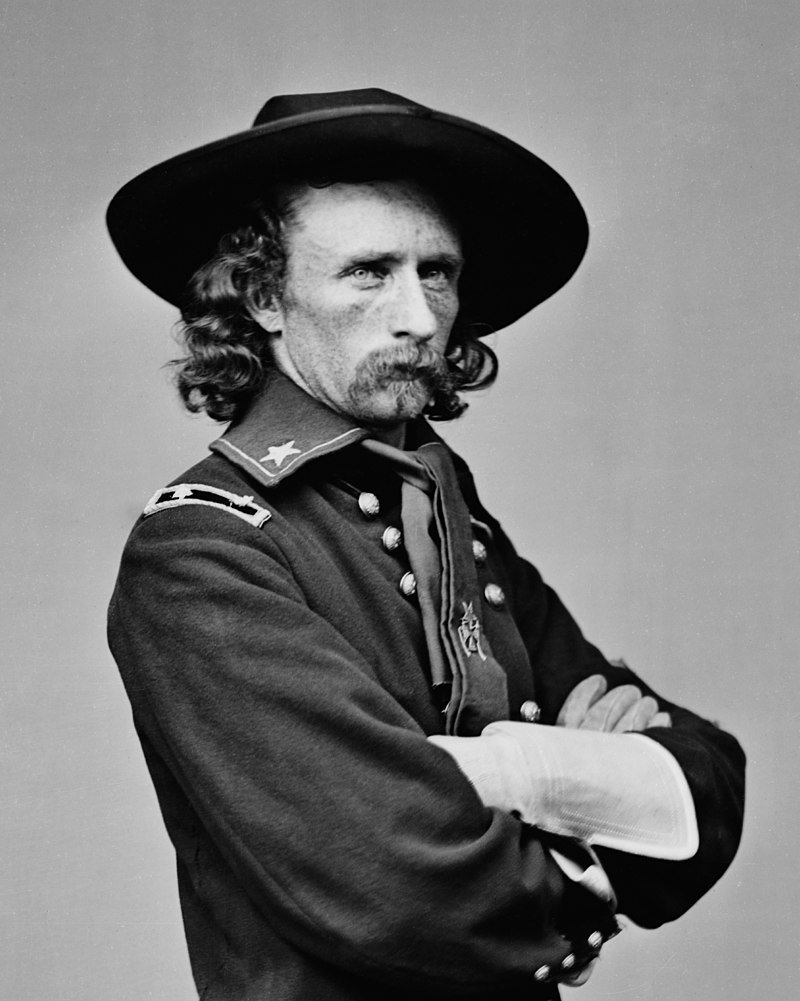
In 1693 Palatine Paulus Küster and his wife Gertrude arrived in America from the Rhineland in what is now Germany. Like the thousands of Palatines who would follow them to New York and Pennsylvania they were fleeing the wars that had ravaged their land for years. A little over 150 years later one of their descendants would prove himself to be one of the most adept men at war in American history.
George Armstrong Custer was born on December 5, 1839 in Ohio. He moved to Michigan with an older sister in order to attend school there. At 18 he earned an appointment to West Point.
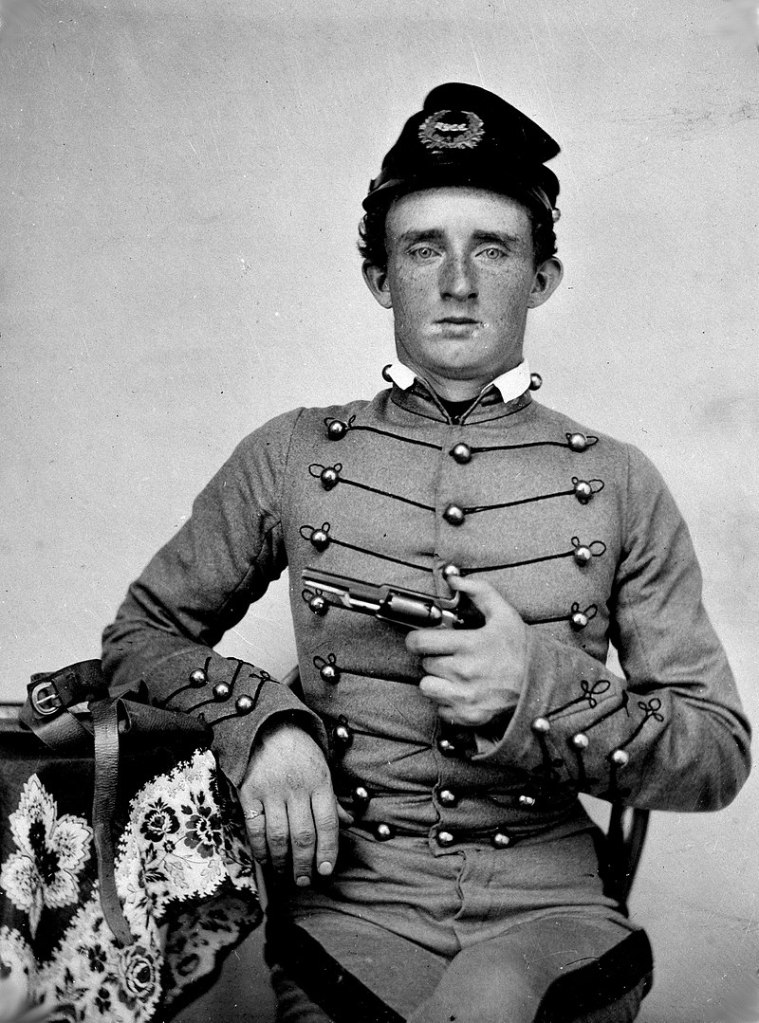
His class at West Point consisted of 79 young men scheduled for five years of rigorous academic and physical training. In terms of demerits Custer was one of the worst students to ever attend the academy. He only just managed to stay below the threshold of demerits that would have seen him expelled from the school. In 1861 with states beginning to secede from the union it was decided to graduate Custer’s class a year early, after only four years of training so they could serve in the Union army which was in need of trained officers. Custer graduated 34th of 34 students in the class. 23 students had dropped out for academic reasons and 22 had dropped out to fight for the Confederacy.
Custer was appointed a 2nd Lieutenant in the cavalry in time to join the army at Bull Run and during the Peninsular Campaign. At Chickahominy Custer led a small cavalry attack that captured several prisoners and the first Confederate battle flag of the war. He was promoted to captain and took part in the Battle of Antietam.
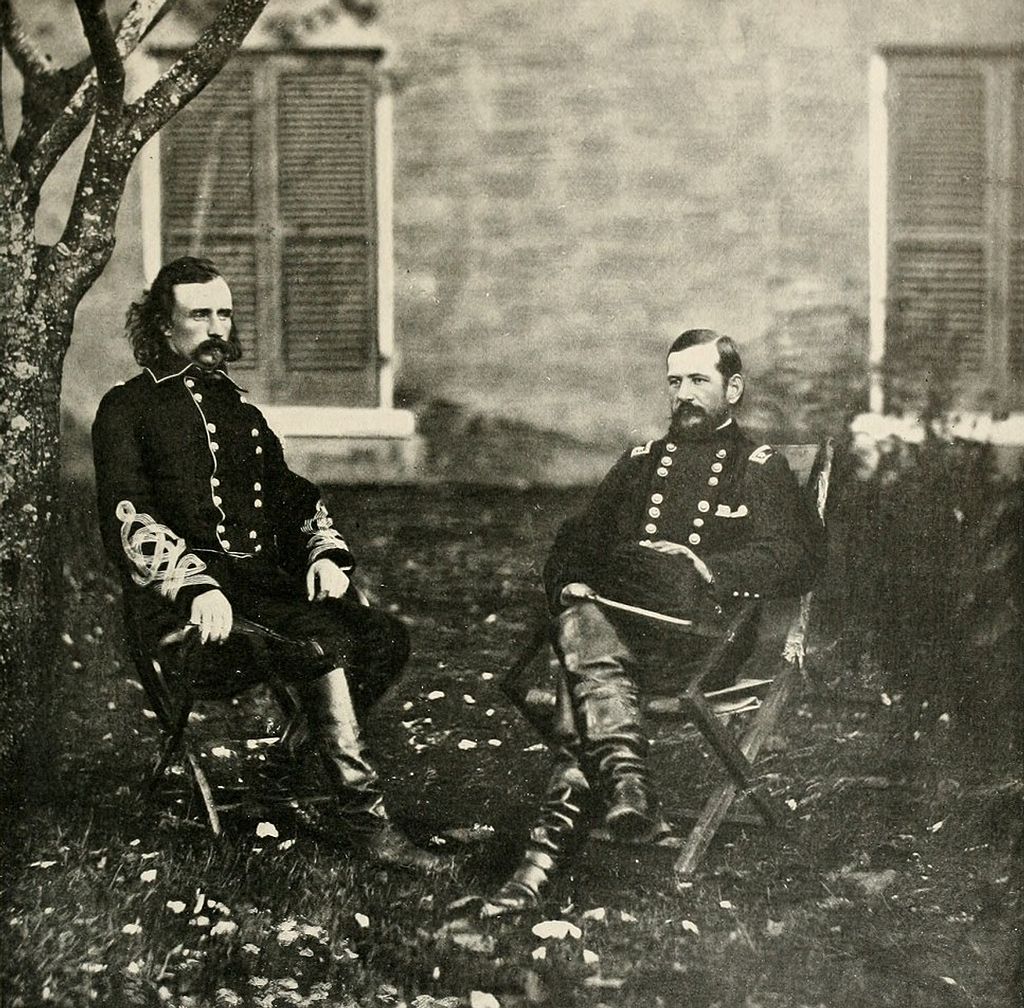
At the age of 23 Custer was promoted to brigadier general, he was called the Boy General. He earned a few other nicknames for his famous endurance in the saddle including “Iron Butt” and “Hard Ass.” This was just before the Battle of Gettysburg. On the third day of the battle Custer found his brigade, three regiments of Michigan cavalry facing the entire Confederate cavalry under the command of J.E.B. Stuart. Stuart had been sent to loop around the Union army and cause chaos in the rear as General Pickett made his famous, failed charge. Custer, gaudily dressed so that his soldiers could spot him easily in the midst of battle, charged at the head of the troopers. After an intense fight the Confederates retreated, and Custer had saved the army.
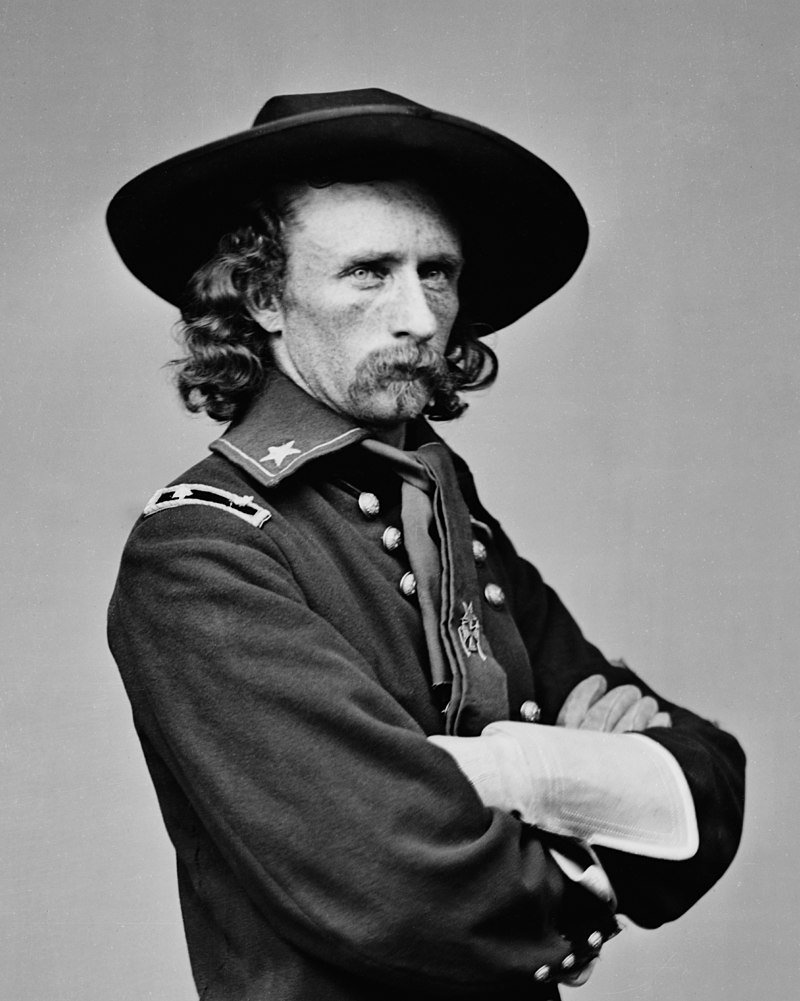
He next spent several months fighting in the Shenandoah Valley causing chaos and destruction in the “breadbasket” of the Confederacy. On March 13, 1865 he was promoted to major general and lead a division of cavalry around the Confederate army cutting off their retreat and forcing Robert E. Lee to surrender a few days later. The table on which Lee signed the terms of surrender was sent to Custer’s wife by Philip Sheridan who said Custer had done more to win the war than any other man.
Custer’s division was mustered out of the army in November 1865. With his division gone, so went Custer’s rank of major general. Custer spent several months trying to decide what to do with his life. He spent time in New York City considering going into business, he traveled back to Michigan where he considered running for congress, but finally it was the army where he was most comfortable, and he accepted the post of lieutenant colonel of the 7th Cavalry stationed in the west.
Custer spent the next ten years fighting in the genocidal Indian Wars, where the United States army was used in an effort to either exterminate the western Native American tribes or drive them onto government reservations. For example, at the “Battle” of Washita River Custer attacked Black Kettle’s Cheyenne encampment. Many Native American men, women and children were killed, and many more women and children were taken prisoner. Somewhere around 875 horses belonging to the Cheyenne were killed. Black Kettle had no choice but to go onto a government reservation.
In 1873 Custer began his battles with the Lakota. In 1874 he discovered gold in the Sioux’s sacred Black Hills which caused a gold rush. One of the towns that sprang up because of this was the famous Deadwood.
On May 17, 1876 Custer led the 7th Cavalry out of Fort Abraham Lincoln. It was to be an extended scout. He turned down additional units from another cavalry unit. He turned down to gatling guns to support him and most bizarrely of all he ordered his troopers to leave their sabers behind. He was soon on the trail of a very large native camp, which consisted of members of both the Sioux and Cheyenne tribes. Custer caught up with them at the Little Bighorn River. He divided his men into three groups. One under his command, one under the command of Major Reno and one under the command of Captain Benteen. Reno chose to dismount his men and form a skirmish line instead of charging into the camp as Custer had ordered, which allowed the Sioux and Cheyenne to pin him down with a small part of their fighting force, while the rest faced Custer and his detachment. Custer had ordered Benteen to join him with more supplies but Benteen chose to disobey orders. The rest of the story is well known. Custer and his detachment massacred while Reno and Benteen held out for the rest of the day before the Sioux and Cheyenne moved on.
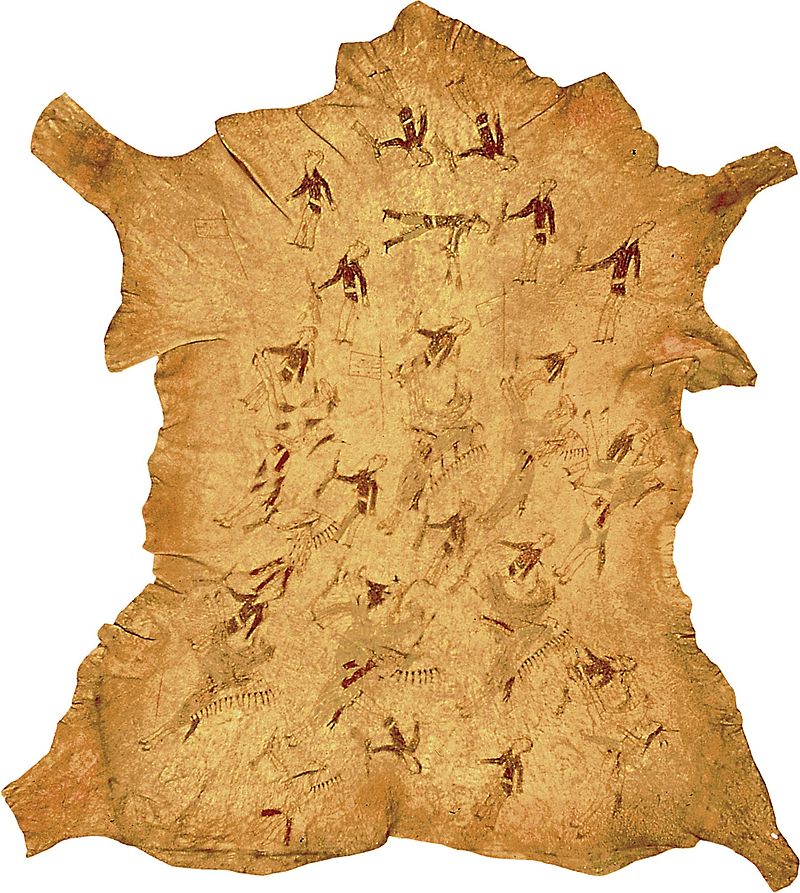
There are several contemporary accounts that change the famous image of the battle. For one thing, from period accounts, few if any of the Native Americans knew they were fighting Custer. Much of the battle was fought at a distance and Custer was no longer as recognizable as he once was. The long golden hair for which he had been famous for during the Civil War had been trimmed close to his head as his hair began to thin. The buckskin coat he famously wore in the west had been rolled up and tucked behind his saddle as the day was quite warm.
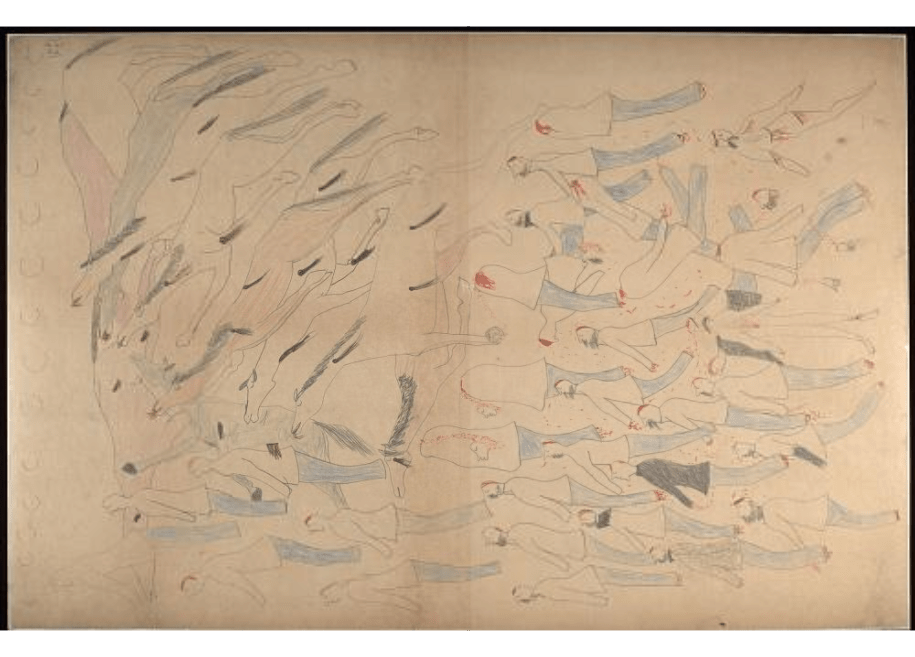
The image of Custer standing in a ring of cavalry troopers as the Sioux and Cheyenne closed in is also probably wrong. In 2005 traditional Cheyenne story tellers finally told the story of Buffalo Calf Road Woman who is said to have unhorsed Custer before he was killed. One bullet in his head another close to his heart.
Unfortunately for the western Native Americans Little Bighorn would be their last major victory of the army. Many more Native Americans would die, and the rest would be forced onto reservations. The American government would break treaty after treaty leading to the current reservation system.
In 1877 the remains of what was believed to be Custer were exhumed from the Little Bighorn battlefield and reinterred at West Point where he would be joined many years later by his wife.
Palatines moved to America to escape war. It is ironic that their descendants would be forced to fight in many wars, the colonial wars, the American Revolution, the Civil War, the so-called Indian Wars and all the wars since then. Palatine men and women have shaped the course of this country from its very beginning and continue to shape it today. Thousands of Americans can trace their origins back to the Palatines. Custer is just one example.
 Clermont State Historic Site
Leave a comment