 |
| Alastair rowing on an African lake during an R & R leave. Note the bandages on his hands covering blisters from his work in the desert. |
This is the fourth in a series of five blogs that will explore the life of Katharine Livingston Livingston Timpson’s children. If Katharine was Clermont’s forgotten daughter, her children are the forgotten grandchildren. Whereas Katharine’s sisters Janet and Honoria had no children, Katharine had five children. They lived their lives aware of their Livingston legacy but free to pursue lives outside of the Hudson Valley. I owe a tremendous debt to Robert Timpson, one of Katharine’s grandsons, for the information he has provided on his father and his father’s brothers and sisters. Also, to Yanni Moller, a great-grandson of Katharine’s who has also provided a great deal of information on that generation.
 |
| Woodstock House |
John Alastair Timpson and his twin sister Rosamund were born at Woodstock House on the grounds of Blenheim Palace in 1915. They would be the last children of Katharine Timpson and her husband Lawrence Timpson. The children had a Flemish nurse who cared for them deeply. Zelly, taught the children French and some Flemish which eventually allowed Alastair to become fluent in German as well, a skill that would come in handy later in his life. As they grew older they spent time at their mother’s house, Appleton Manor in England but frequently visited a holiday cottage Katharine had purchased in Coq Sur Mer called Beguinage.
At the age of 13 Alastair entered Eton and upon finishing his studies there attended Trinity College, Cambridge University. He achieved notable athletic success while at Trinity, in rowing, riding, and skiing. Perhaps his greatest athletic feat came in 1936 when he ran from Cambridge to London and back in 23 hours and 2 minutes, a distance of 106 miles. He won several bets which added up to nearly £250, which would be roughly $25,000 today. According to the Canberra Times his last refreshment along the way was an iced orange squash, a concentrated fruit juice often mixed with alcohol although it can be, and most likely was in this case, mixed with water to make a refreshing drink.
 |
| An example of a Railton similar to the one Alastair drove |
His college years were not all positive though. His mother died when he was 17 followed by his father when he was 21. Perhaps feeling a bit untethered from his home and family with the death of his parents, Alastair left Cambridge in 1936 and bought a Railton. He traveled through Europe and North Africa. He also tried to strike it rich gold mining in South Africa. In 1940 he married Phoebe Houston-Boswell, with whom he would have four children, Nicholas, Gerald, Rupert, and Veronica.
 |
| Alastair\’s children at Christmas 1953 |
Alastair was made a captain of the Scots Guards and volunteered for service in the Long-Range Desert Group. During the war patrols of approximately 20 men would operate behind enemy lines, observing the German and Italian movements and reporting them to their headquarters. They occasionally engaged in sabotage or ambushes as well. It should be noted that his soldier-servant at this time was Thomas Wann, formerly the goalkeeper for the Aberdeen Wanderers.
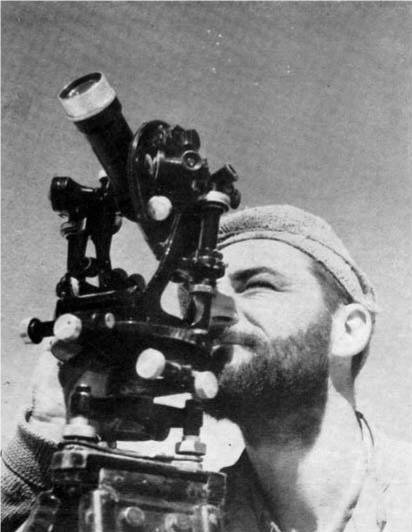 |
| In the days before GPS the LRDG navigated with celestial instruments |
Alastair and his men’s job during 1941 was incredibly dangerous. They met it with a sense of humor as when Alastair took his first ride in the group’s plane, an unarmed WACO I. He loaded his pistol in case defense was necessary at which point the navigator turned to him and shouted “Don’t shoot the pilot. He’s doing his best!”
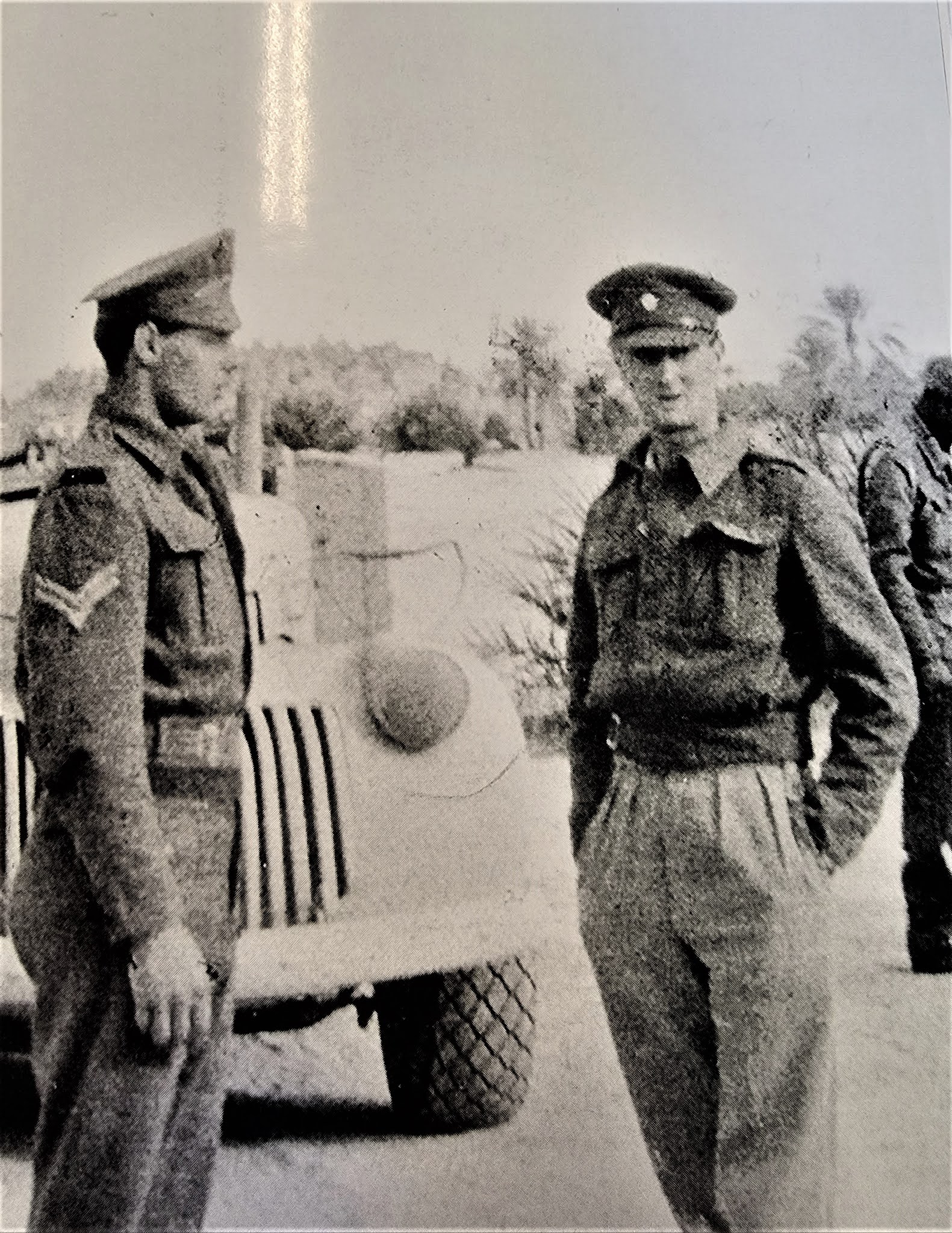 |
| Alastair (r) with a corporal of the LRDG |
Humor aside, the mission of the Long-Range Patrol Group also took a tremendous grit. They travelled hundreds of miles through the desert with temperatures bottoming out at 0°F at night and rising to 120°F during the day. Scorpions and other animals that loved to bite or sting unsuspecting soldiers. They traversed sand dunes that were nearly impossible to read. Alastair once fractured his skull when his jeep drove over a dune that dropped sharply away on the other side. His soldier servant, Wann was paralyzed for the rest of his life.
 |
| Thomas Wann in Alastair\’s jeep prior to the accident that would paralyze him. You can also get a sense, based on his size, of why Alastair jokingly referred to him in his memoir as his \”quarter-ton soldier servant.\” |
Even though they did their best to remain camouflaged they were occasionally forced to engage in fire fights with German or Italian soldiers. Men were killed. Men were captured. On one occasion Alastair and another solider found themselves in the camp of a group of Bedouins who had allied themselves with the Germans. Alastair pretended to be a German officer, using his fluency in German that his lessons with Zelly had allowed him to gain, to prevent being taken prisoner. Another time while doing a road watch to count German vehicles a large section of the German Army set up camp around a bush Alastair and another soldier were hiding in. They attempted to slip away in the dark but were spotted. As they ran the Germans fired at them and Alastair and the other soldier were separated. By hiding and running through a wadi Alastair was able to make it to his rendezvous point in time to prevent any more soldiers from heading toward the German camp. The next day Alastair took a jeep out by himself and rescued the soldier who had been separated from him the night before.
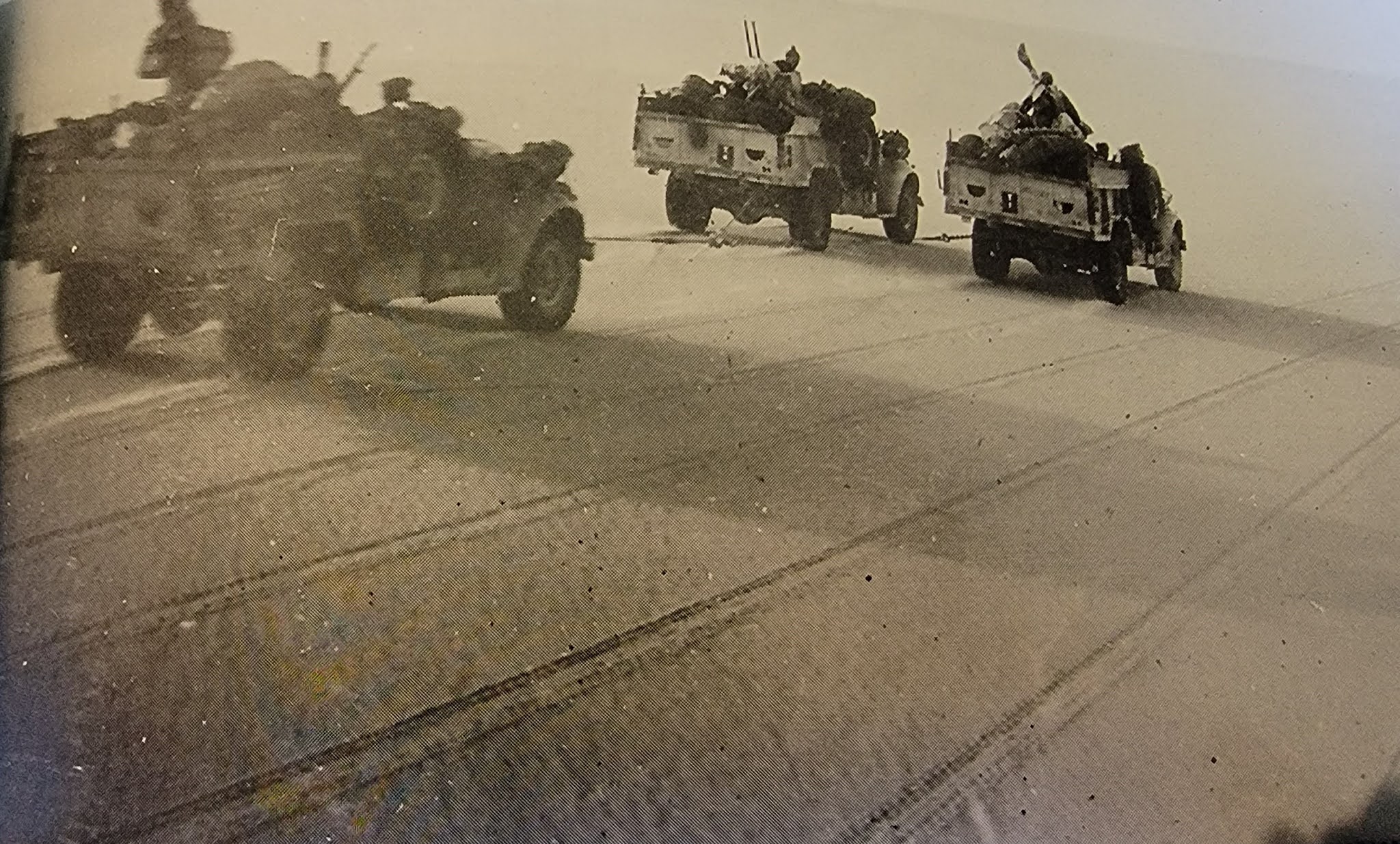 |
| The LRDG on the move across hard sand. Often their tire tracks were followed by German or Italian planes and led to bombings or straffings if they could not hide quick enough. |
After a year in the LRDG Alastair returned as a company commander to the Scots Guards. On April 25, 1943 he was wounded by an Italian hand grenade. He recovered from that wound in time to take part in the Invasion of Salerno. After two months of fighting the Scots Guards had suffered thirty-seven officers wounded including 16 killed. At the Battle of Monte Camino, Alastair was wounded again. On the night of November 11-12, 1943 an artillery shell landed a direct hit on Alastair’s company headquarters. Several men were killed, and several were severely wounded. Alastair would spend the next six months in hospitals before he recovered enough to be sent home. His war was over as shrapnel left his right arm nearly useless. Alastair was awarded the Military Cross, England’s third highest military medal, for his service in the army.
After the war Alastair engaged in several financial ventures as a stockbroker and travelled extensively. One business trip took him to Beirut for the company Cazenove, where he was attempting to set up a Beirut stock market. Unfortunately, the Suez Crisis, during which Israel, Great Britain and France invaded Egypt, made British citizens unwelcome and he had to leave quickly. He owned a large house called Great Waltham in England at this time.
Alastair married Aline Hunter Blair in 1964. Together they moved to Chelsea. When Alastair retired, they moved to the village of Castle Combe in the Cotswolds. Alastair loved to garden and spend time with his family.
Perhaps it was his many brushes with death during the war or perhaps it was a character feature deeply ingrained in him, but Alastair was a tremendously caring man. During the war, he was offered several jobs that would have kept him relatively safe but consistently chose to stay with his men. This extended to his family after the war. He was infinitely compassionate, encouraging and embracing of his family.
Alastair died in 1997 at the age of 82.
N.B. Alastair left behind a manuscript detailing his service in the LRDG which was published posthumously as In Rommel’s Backyard: A Memoir of The Long Range Desert Group. Edited by Andrew Gibson-Watt.
 Clermont State Historic Site
Leave a comment