Former Clermont Curator Travis Bowman explains the beginnings of the Livingston Fulton steamboat…

Imagine a time heavy with optimism. The old ways were gone, the slate symbolically wiped clean by the Revolutionary War. The fledgling Republic, though less than perfect, was full of promise and potential; America was a land where anyone could make his mark. Freedoms dreamed about in the Declaration of Independence, earned during the Revolution, and held inviolable in the Constitution gave America her confidence, and the American dream materialized as the nation was born.
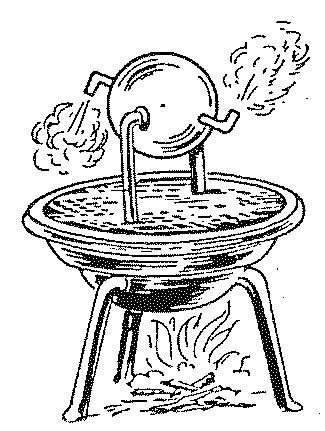
The world’s first commercially successful steamboat was born from this optimism. But Fulton’s 1807 “folly” is the end of the story, not the beginning. 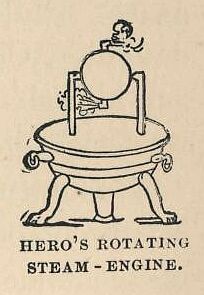 The story actually began 2,000 years earlier when ancient Greek engineers and inventors first experimented with steam power. One of the earliest known references to the steam engine occurs in Hero (or Heron) of Alexandria’s book The Pneumatics. There, Hero described an “aeolipile” or wind ball, a basic steam engine that heated water in a copper globe and allowed steam to escape from two jets and cause the aeolipile to spin rapidly. Hero’s engine was considered an amusement and was never put to a practical application. Although other great ancient scientists periodically put steam power to limited uses, no records survive of their attempts to use it to propel a vehicle. With the fall of the western Roman Empire in 476 AD, scientists in western Europe lost the knowledge of its classical ancestors, and steam power would have to wait centuries to be rediscovered.
 The steam engine reemerged for good in seventeenth-century England where industry and mining were gaining footholds and enterprising engineers were searching for labor-saving solutions. The Industrial Revolution and the steam engine thus went hand in hand, and bigger, better machines were needed to keep up with demands. Between the invention of first practical steam engine in 1698 and the development of Boulton and Watt’s rotative engine in 1781, faster and more efficient steam engines rapidly evolved. Although these modern steam engines were developed for mines and factories, almost as soon as they were produced, enterprising souls began conceptualizing how to strap one onto a vehicle and make it move.
A series of near-misses is the best way to describe early efforts at steamboat engineering. Inventors like Denis Papin (1707), Jonathan Hulls (1736), and partners Nicholas Roosevelt, John Stevens, and Robert Livingston (1798) 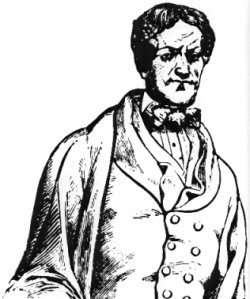 built crafts that were simply not powerful enough to move effectively. Others, like William Henry (1763), the Marquis Claude de Jouffroy (1783), and Robert R. Livingston (1793), built boats that sank under the weight of their heavy steam engines. Still other inventors built working, practical boats that failed to attract a winning combination of interest or investors. This last group of “near-missers” included John Fitch (1785, pictured at right), James Rumsey (1786), Samuel Morey (1792), William Symington (1802), and Oliver Evans (1805).
Why then was Robert Fulton successful where so many others had failed? Look for the answer in next week\’s blog!
 Clermont State Historic Site
Leave a comment