For many modern Americans casual home dining has limited the importance of setting a fancy dinner table. But at Clermont and in an historic sites around the country, setting and re-setting the dining room table seasonally is something that we put a lot of thought into.
 Setting and re-setting the dining room table at Clermont is rather a big deal. This is for a number of reasons.
First of all, you have to think of almost every single thing on the table (each plate, each fork, each spoon) as a separate artifact. This fact alone means that on any given day, our dining table can be set with 30-75 artifacts which must be appropriately handled, checked for wear, and have their movements tracked so nothing is lost. They can also be composed of up to four materials (metal, ceramic, wood, and one time horn), each of which also has different rules for handling.
 Then you mix in the props–faux food, flowers, and decorative items–and you have a lot to manage to create a new table setting. Even something as \”simple\” as changing the table cloth can mean a couple hours worth of work.
 And that\’s just the half of it. Setting the table in an historic house is not just as simple as finding a good ettiquette book and following the instructions. Modern table setting diagrams, like the one at right, can be found all over, along with lovely ideas for fancy table settings, but I\’m not setting a modern table.
–What kind of meal? Daily dinner? Formal party?
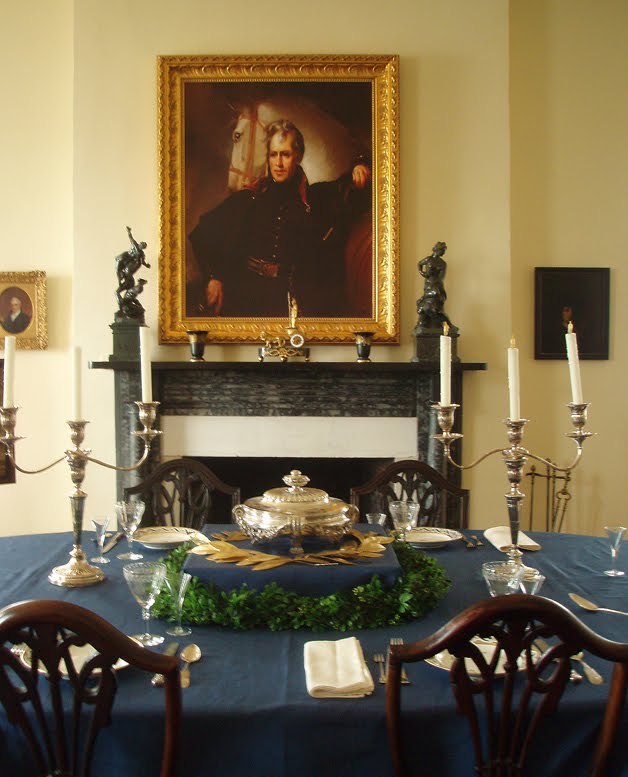 I need to think more about what Alice and John Henry Livingston would have liked just 100 years ago, but Alice did not write about her dining room table–at least not in anything that I have found yet. I have to get a little more creative with my research.
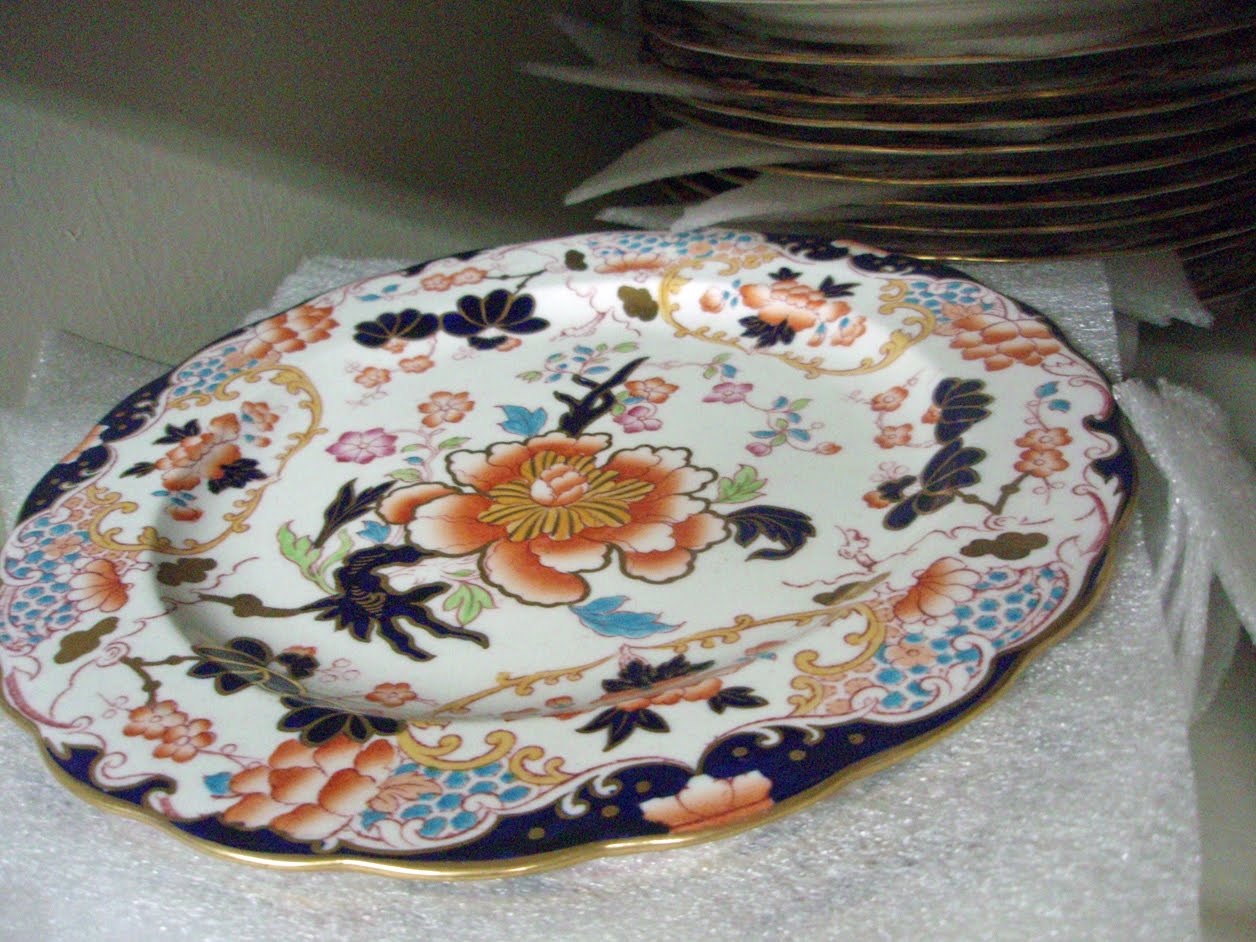 Moving on to dishes, I have a reasonably broad selection to consider. All of them come from different time periods as far back as the late 18th century, but Alice liked to use the old dishes to show off her family\’s herritage. She would have picked and chosen what colors and patterns fit the season and her personal tastes. There\’s a nebulous descriptor for you–her personal tastes. It\’s hard to guess at someone\’s taste when they\’ve been deceased for fifty years. At least I know what she didn\’t like. Alice tucked away the plates shown at right away in the Cow Barn for years. They would have been fashionable during her youth, and Alice\’s decor did not favor Victorian touches like this.
 Instead she seemed to favor things that came from a few generations earlier, particularly the Federal era (around 1790-1820). These would have blended better with her Colonial Revival decor. The serving dish at left for instance was purchased by Chancellor Livingston in France around 1801, and would have provided Alice not only with a pretty table setting, but also a good excuse to talk about her fine pedigree.
 Once I have my dishes, silverware, and glassware picked out, then comes time to lay them all out. It\’s not just as simple as \”forks on the left, glasses on the right\” like I do at home. Instead I rely on Alice\’s little book of \”Table Service and Decoration.\” I\’ve already blogged about this book\’s wearying collection of rules for table ettiquette. It\’s not even all that complex in the grand scheme of history. But it gives the propper layout and usage of each little piece of silverware and dish–right down to which way to point the knife blade (in towards the plate).
 No fancy dining table could be complete without a centerpiece (check out Staatsburg State Historic Site\’s at right!), and at Clermont these range from the simple to the large and elaborate. Fashion for centerpieces changed regularly dating back for centuries. At some points, huge sugar creations of classical buildings (complete with working canals and boats) could adorn a high profile party table. Long-standing traditions focused on floral arrangements or evergreens in the winter, augmented with porcelains, ribbons, or other colorful bits. Period magazines are repleat with ideas, further supporting the concept of how important they were.
 The secret to a good centerpiece has turned out to be getting some height (we generally insert some thick books or upside-down dishes in the middle) to build an appealing overall shape. If you have one (though sadly we do not) a good epergne adds an historical touch of class.
  Some of these date back to 18th century and were filled with colorful candies and other things that would add beauty to a table. A tall fruit bowl (below) or footed compote (right) is a good second, and our tall candlesticks on either side add some height as well. Alice\’s centerpieces can\’t be too tall or that diners could not see over them. On longer dinner tables, you were expected to talk to the diners on your right or left, but with only six place settings here, it would be a bad idea to build a wall between sides of the table.
 Voila! The table is complete. After a few hours of research and a few more of moving artifacts, the seasonal table alterations are complete. The next time you stop by a historic site and pause in the dining room to admire a well-set table, be sure to remember just how much thought went into each bit of it. Or perhaps, like me, you can take a few of these handy suggestions home and impress your own guests. Ever since I got my own footed compote as wedding gift (I do wish I\’d registerd for two), I have been gradually adding my historic table wisdom into table settings. Even if it doesn\’t help me cook any better, at least it makes my dinners look good.
 Clermont State Historic Site
Leave a comment