I\’ve written about silhouettes a bit before around Halloween, but today my interest was piqued by a more traditional application…
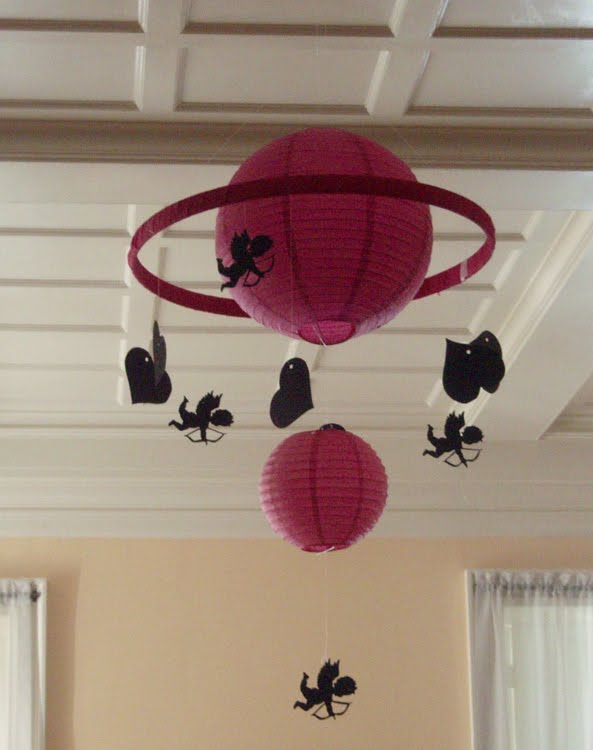 I\’ve been up to my old tricks again while decorating for Clermont\’s annual Valentine\’s Day fundraiser. I just can\’t pass up an opportunity to make a paper chandelier.
 But silhouettes have a much longer and more interesting history than just serving as convenient party decorations, and I thought today would be a good time to pay some homage to that. I took a little time to gather up what information I could find about them.
 Beginning in the 18th century, the term \”Silhouette\” was applied to a profile portrait cut from black paper or card and often affixed to a white background (at right you can see Jane Austin\’s silhouette made circa 1810-1815). Though cut paper was the most common, the images could also be created by painting or drawing, and in 1802 painter Charles Wilson Peale even invented a machine that would assist with the creation of precise silhouettes. However, most continued to be made using the human eye and deft use of a pair of shears.

At Clermont, we have two silhouettes currently on display in the study. Displayed in oval frames on little stands like egg cups, the two men\’s heads depicted are not more than an inch or two tall. At left you can see the head of Edward Philip Livingston, who lived at Clermont during the beginning of the 19th century. It\’s not that Edward couldn\’t afford a more elaborate portrait. Off the top of my head, I can think of at least two others and a handsome bust of the man (though oddly enough, we have no images of his wife Betsy).
Instead, he went searching for this specific art form. Silhouettes had developed a life of their own. They continued to be popular well into the 20th century, when photography offered a cheaper and more accessible solution for preserving one\’s likeness. I can\’t help but think of the little 6\” silhouettes of my mother and her sister as children in the late 1950s that hang on my grandmother\’s bedroom wall. My guess is that it was probably much easier to find a camera at that point than a silhouette artist, but the charm and nostalgia of the silhouette had been sealed in the public imagination.
 Today silhouettes continue to hold our fascination. They have developed their own following of collectors (I got lost on this gentleman\’s blog for about half an hour while writing my entry). They have become the subject of a very lovely book called Silhouette: The Art of the Shadow, and silhouette artists continue to create amazing art. If you are feeling adventurous you might try cutting your own silhouettes according to these directions on ehow.com. But with a quick search of the internet, I even found a few artists in New York and Rhode Island, as well as more distant locations. (Pictured right are works by artist Deborah O\’Connor. A local artist also contacted me recently about my October silhouette post, though I have to apologize for misplacing her information, and I hope that she will post it in the comments for this blog).
After making my own decorative silhouettes for a few years now, I can say that I\’ve come appreciate the expressiveness that an artist can coax out of a flat piece of paper. Whether it is the unmistakable lump in Harriet Livingston Fulton\’s nose or a child\’s pouty lips and curling hair, the dependance on outline only is a difficult artist challenge to meet succesfully. While I was biting my tongue in concentration and trimming around the feathered wings of that Cupid, I was feeling that appreciation even more acutely.

 Clermont State Historic Site
Leave a comment