The third installment in my Halloween series…
 When I started decorating Clermont for Halloween, it seemed to me that historic party decoration was all about paper. I\’ve already discussed silhouettes in this blog, paper decorations also included Chinese paper lanterns, printed place cards, die-cut decorations (pictured at left from an eBay auction), and copious usage of crepe paper.
 Chinese or paper lanterns were linked to Halloween as far back as the 1880s, when Halloween parties began to gain popularity. Their light was considered \”myseterious\” or remiscent of fairies, and thus perfect for a holiday built around mystery and the occult.

Eventually Dennison, a paper company, began annually releasing decorating manuals they called the \”Bogie Book.\” This manual provided detailed instructions for decorating homes and halls with elaborate creations of crepe paper. Many 1920s and 30s examples of this magazine survive today, and they have become quite the hot-ticket item on eBay, but you can also purchase scanned copies for much cheaper if you are more in search of the information than a collectors\’ item. For those of us looking to recreate an accurate image of historic Halloween, they are an absolutely invaluable source, and the images they provide are relatively easy (if time-consuming) to replicate.
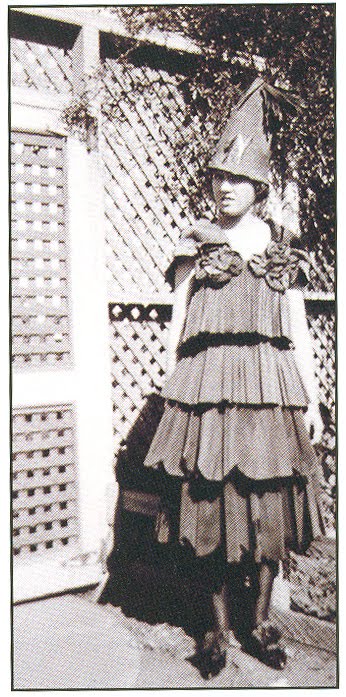 In the \”Bogie Books,\” brightly-colored crepe paper showed up in the not only as pretty streamers, but as costumes! As you can see from the photo at right (taken from Diane Arkins\’ book Halloween Merrymaking), whole costumes were constructed by mounting brightly-colored crepe paper onto a simple cotton dress, slip, or even pajamas. Personally, this always struck me as ironic for a holiday associated with games that involved a lot of candles. Few disaster stories have been passed down to us however, leading me to believe that somehow people managed to keep their costumes and their candles far enough apart.
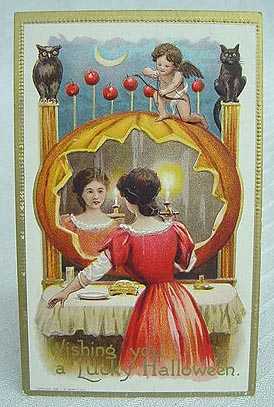 By far my favorite pieces of memorabelia from early 20th century Halloweens however are the post cards. First imported to the United States in the first decade of the 20th century, these cards provide a rich source for information, inspiration, and even use in decoration. They depict the scarey, romantic (yes, romantic), mysterious, and nostalgic sides of Halloween. Last year, I scanned and printed some to serve as place
 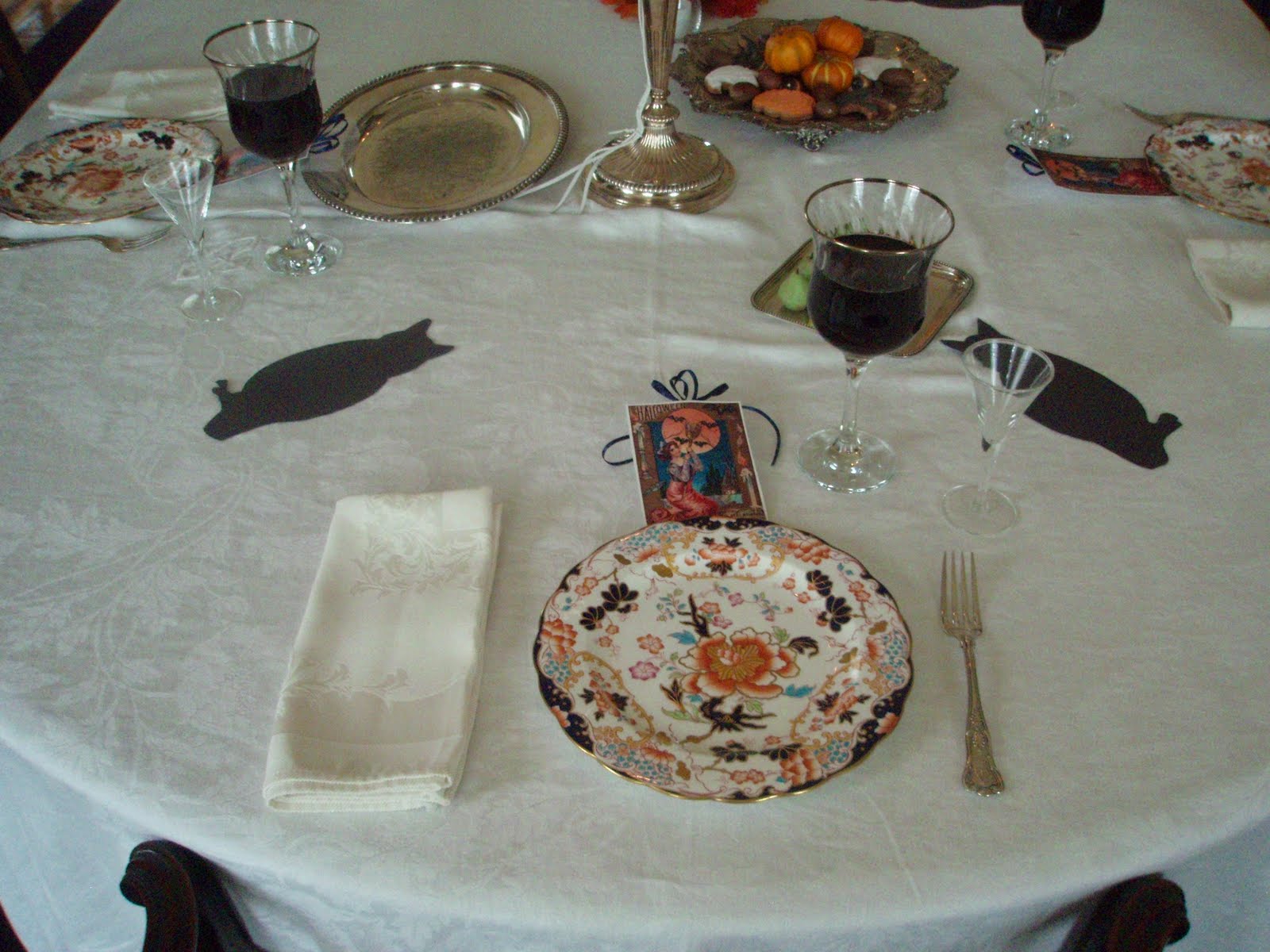 cards on the dining room table. The brilliant colors of the original lithography added just the right touch to the dining room table.
 I\’m relieved to have some of these products available to me as I am cutting and taping my way towards the Legends by Candlelight Spook Tours. Some mass-produced items from the 1920s are hard to reproduce without the technical machinery–that ghost garland is definitely not a do-it-yourself product–and they add that much more authenticity to my decor.
  Clermont State Historic Site


Leave a comment