 As I mentioned in my previous post about paint analysis here at Clermont (“Painted Ladies”, March 27 2009), it is important, when we look at a historic house and its furnishings, to remember that things are not always exactly as they seem. Often, our collections hold secrets, and it is only with a well trained eye, or some in-depth research, that we can learn more about them.
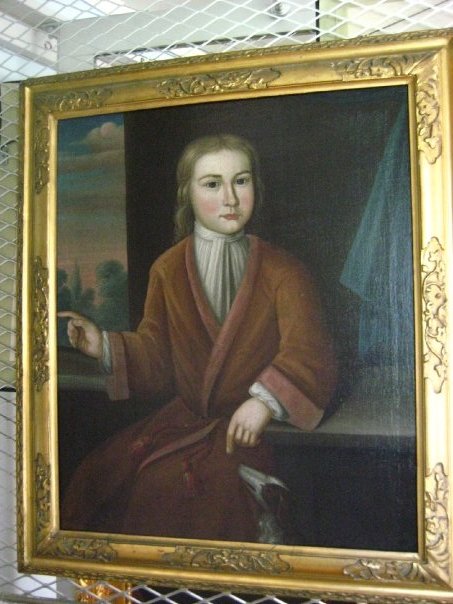
 This was the case this week with one of our portraits- a painting of young Henry Beekman, the brother of Margaret Beekman Livingston. In preparation for the inclusion of this painting in an exhibit in our upstairs exhibition gallery, I needed to do some research, and I began in the file we have on the painting.
The file provided a little information on the painting’s history, but nothing particularly unusual or interesting. In addition to hanging on the walls of Clermont, Henry Beekman has also been exhibited at the New-York Historical Society in 1973, and the Dutchess County Historical Society in 1989. In 1968, the painting was conserved, where it was given a new stretcher (the wooden support on which the canvas is stretched- click here to see an example of a modern stretcher), an old hole was strengthened, and the painting was re-mounted in its frame. This photo shows the back of the painting, with the supports that were added.
 While the file did not include any additional historical information on the painting, it did list that it was attributed to Gerardus Duyckinck (1675-1742). Duycknick was a Hudson Valley limner, a painter of the 18th century who worked in a style characteristic of the Hudson Valley. Paintings attributed to Gerardus Duyckinck, who came from a family of limners, can also be seen at the Albany Institute of History and Art, the New-York Historical Society (including a portrait of a Depyster boy with a similar dog to the one shown with Henry Beekman), the Philadelphia Museum of Art, the National Gallery, and the Crystal Bridges Museum of American Art.
Now for the interesting part: in the course of my research on the painting, I showed a photo to several other curators and art historians. One comment stuck out—I was asked if the photo was of the whole picture, as it was cropped somewhat strangely. In other portraits by Duyckinck, the sitter is posed with a dog, but usually the whole dog is shown. Also, cutting the sitter off at the knees is rather odd- usually portraits show the whole body, or cut the figure at the waist or just below the shoulders.  Finally, the way Henry Beekman’s right hand goes right to the edge of the canvas is strange.
  To our modern eyes, the painting may not look strange at first– we are accustomed to photographs cropping our world in strange ways– but before the advent of the camera, such cropping was not done on canvas.
As soon as I returned to Clermont, I gave Henry Beekman a second look. Looking at the back of the painting, I could clearly see the new stretcher, the metal supports that were added to keep the painting from rubbing against the frame, and the new canvas lining that was applied to the back of the original canvas. Closer observation revealed the edges of the original canvas. Here, one can see that the painted design goes all the way to the edge, and the edges are irregular.
 This is especially true on the bottom and the proper left side, the areas that seem most likely to have been trimmed. So, it seems, Henry Beekman was once a much larger portrait! Hopefully, further research will reveal more of the story of this painting, especially during its life with the Livignston family!

 Clermont State Historic Site

Leave a comment